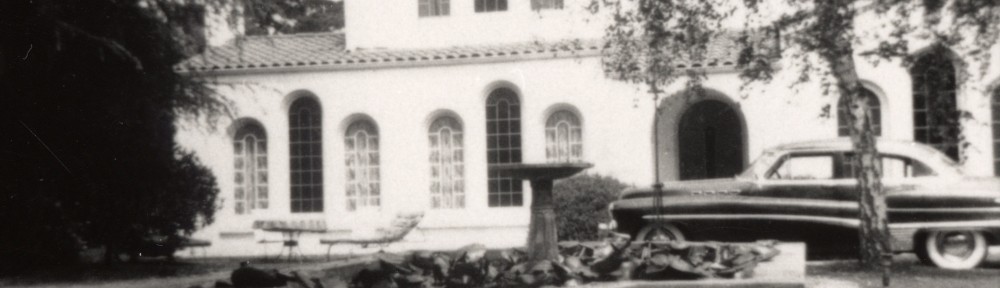
Yom Kippur 2026

I gave a shortened version of this speech on Monday, September 21, 2026 for the Yom Kippur Martyrology service for Family Minyan at Sinai Temple in Los Angeles.

As all of you who were here on Rosh Hashanah know, Saturday September 12 was also my birthday.  I didn’t recall Rosh Hashanah falling on my birthday before  — in fact, it happened once before in my lifetime, in 1988 when I was in law school – so I figured a Shabbat Rosh Hashanah on September 12 might be especially rare and decided to ask my new friend ChatGPT when was the last time a Shabbat Rosh Hashanah had occurred.  The answer was Saturday, September 12, 1942.  (The next one will be in 2178, so I hope everyone enjoyed this last one.)

1942 wasn’t a great year for the Jews.  No matter how tough we all think things are today, it’s not even close to 1942.  As many as 3 million Jews were murdered in 1942, mostly during the three month period between August and October 1942, when on average over 14,000 Jews were murdered every day.  On Rosh Hashanah 1942, my great-grandfather Siegmund Zeisl was in Theresienstadt, an old Bohemian military garrison turned into a concentration camp by the Nazis.  You might hear some refer to Theresienstadt as a “model camp” where Jews were able to paint and play music and survive relatively unmolested, at least as compared to the extermination camps further East.  That doesn’t tell the full story.  In the summer of 1942, trainloads of Jews were sent to Theresienstadt so that the population, in a military garrison designed for 5,000 to 7,000 soldiers, rose to 58,491 people.  Let that number sink in a bit.  For every soldier’s bunk there were about eight Jews who had to try to find a place to sleep.  A huge portion of that population consisted of older Jews from Vienna. 

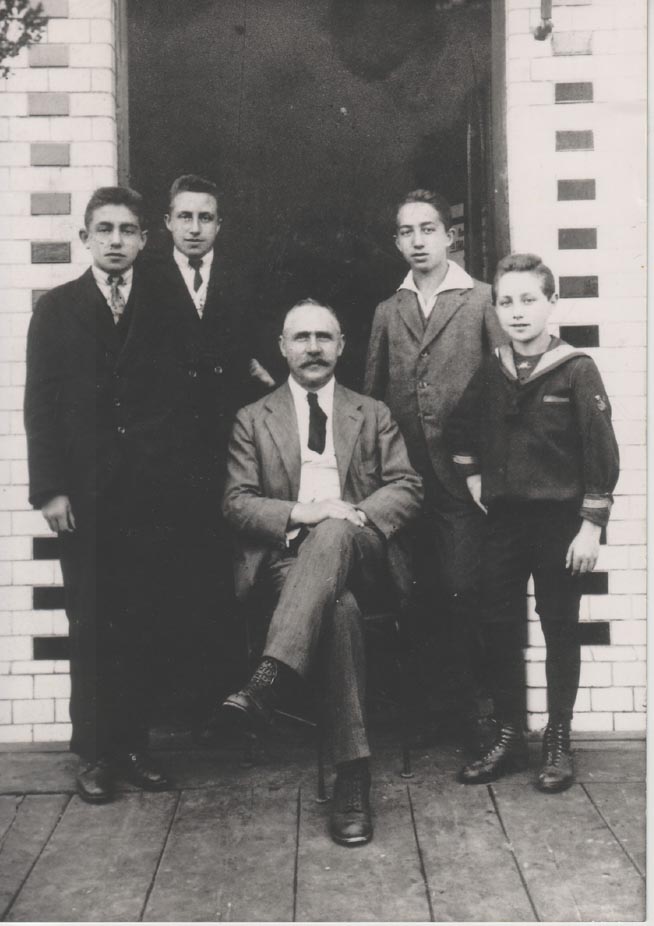
My great-grandfather Siegmund Zeisl had been born in Vienna on September 8, 1871, so he had his 71st birthday in Theresienstadt just days before Rosh Hashanah.  Siegmund was the fourth of six children.  His father Emanuel had supposedly walked from his home in Moravia to Vienna as a young boy and apprenticed as a locksmith.  The profession was lucrative during that era when all the big buildings were being built in the Austrian capital city.  The story goes that he set up each of his children with a way to make a living, and since Siegmund was not the most natural businessman, Emanuel bought him one that couldn’t fail — a coffee house across the street from the train station in Vienna’s second district where all of the new immigrants arrived from the East.  There Siegmund and his wife Kamilla raised four boys, the third being my maternal grandfather Eric Zeisl. 

Siegmund Zeisl with his sons Eric, Egon, Walter and Willi in front of his home at Heinestrasse 42 in Vienna.

When the Nazis annexed Austria in the Anschluss of March 1938, the boys all prepared to escape to America.  My own grandparents managed to flee on the day after Kristallnacht in November 1938.  But Siegmund and Kamilla stayed behind.  Kamilla was not well and could not travel.  She died of cancer in February 1940.  My mother was born in New York a few months later, and her grandfather Siegmund was thrilled to hear about his first grandchild.  Kamilla’s sister Malvine, a widow, had taken care of her sister and Siegmund during Kamilla’s illness.  In March 1941, Siegmund and Malvine married, in part to assure that they could remain together as Jews were being moved out of their homes into collective homes in the city.  The two of them tried valiantly to obtain visas to join the rest of the family in the USA, but were stymied by the bureaucracy as American immigration quotas went intentionally unfilled on order of the US State Department.  In his last letter, Siegmund described how he had obtained permission to leave from Lisbon on December 5, but that Malvine could only leave in January.  The attack on Pearl Harbor on December 7, 1941 made all further travel impossible.

Little is known about what Siegmund and Malvine experienced next.  On July 14, 1942 they were loaded onto a train from Vienna to Theresienstadt.  According to the procedures there, they must have been forced to leave all their belongings behind at the train station and had to walk two miles in the hot sun to the already overcrowded camp.  As late-comers to the camp, they were housed in the hot upper attics of the buildings that were already full before they arrived.  Their rations were reduced to provide food for the children and younger adults who had to work.  Sickness was rampant and the death toll inside the camp during those months reached astronomical figures (in September 3,941 people died, about 6.7% of the total population).

Siegmund and Malvine suffered for two months in Theresienstadt.  Siegmund had his 71st birthday and then Shabbat Rosh Hashanah on September 12.  On Yom Kippur, Monday September 21, 1942, Siegmund and Malvine were ordered to board a train with 2,020 other older Jews.  Transport Bp from Theresienstadt was the second transport from there to Treblinka.  The train likely arrived on September 23 or 24.  Upon arrival every single one of the passengers who survived the journey were stripped of their clothing and then forced into gas chambers designed to look like showers and murdered.  The gassing process took about twenty minutes.  Afterwards, their bodies were dumped in trenches nearby.

You don’t hear much about Treblinka because it was not also a work camp, like Auschwitz was, and as a result there were almost no survivors.  It doesn’t live in our imagination.  But I occasionally try to imagine what it was like for Siegmund and Malvine, to be left behind as their children fled, to be forced out of their homes, to be stripped of their belongings, housed in unbearable conditions, and then told on Yom Kippur 1942 to board a crowded train only to be murdered on arrival at its terrible destination.

Treblinka, a killing center hidden in a sparsely populated forest and designed expressly for the murder of Jews, only became operational as an extermination camp in July 1942.  Between July and September, 265,000 Jews from the Warsaw ghetto were murdered there.  By April 1943, after just ten months, between 800,000 to 920,000 Jews were murdered in Treblinka, a total second only to Auschwitz where the killing lasted much longer.

You don’t hear much about Treblinka because it was not also a work camp, as Auschwitz was, and so there were almost no survivors. It doesn’t live in our imagination. But I sometimes try to imagine what it was like for Siegmund and Malvine: to be left behind as their children fled, forced out of their home, stripped of their belongings, housed in unbearable conditions, and then told on Yom Kippur to board a crowded train, only to be murdered at its destination.

‘Postscript. I had intended to relate my comments to the war in Gaza and the ongoing offensive misuse of the term “genocide” to describe that conflict, but was advised by Sinai clergy that we were “staying away from speaking about Gaza.” This made me sad, but I complied. If we cannot discuss these issues openly, even before an audience of Jews who are largely, if not unanimously, in agr‘Postscript. I had intended to relate my comments to the war in Gaza and the ongoing offensive misuse of the term “genocide” to describe that conflict, but was advised by Sinai clergy that we were “staying away from speaking about Gaza.” This made me sad, but I complied. If we cannot discuss these issues openly, even before an audience of Jews who are largely, if not unanimously, in agr

I am not new to the study of genocide. In 2010 I opened the new building of Holocaust Museum LA (formerly Los Angeles Museum of the Holocaust), with a new permanent exhibition which I, together with a number of our board members and our archivist, had personally designed. Part of that exhibition was a large wall panel I myself had created on the subject of genocide, describing Rafael Lemkin’s invention of the term, and adding, for the purposes of comparison and contrast, three other recognized genocides in Armenia, Rwanda and Cambodia. The panel itself stood before the museum’s model of the Sobibor extermination camp, re-created by Thomas Blatt, one of the only survivors of a famous escape. When I toured people through the museum, I noted for them that even if you totaled the high estimates of the deaths in the other three genocides, the Holocaust was still the largest, by about 2 million victims.

Some people like to say, well, it’s not the Holocaust Olympics. But of course the numbers do matter. And if there were a gold medal, well, we all know who would win. There have been countless horrendous tragedies in the world throughout history. To the individuals and their families affected by those smaller tragedies they are as important as any other. But the reason we speak so much about the Holocaust is that it was far and away the largest, indisputably the greatest mass-murder in human history. Rafael Lemkin coined the term “genocide” expressly to help us define the phenomenon so we could speak about it, defend against it and prosecute those who perpetrate such atrocities on a mass scale. Every death is a tragedy, but not all deaths are a genocide.

The fact that the Holocaust was by far the largest, and therefore the most important example of genocide to examine and discuss makes lots of people very uncomfortable. For many non-Jews, it engenders feelings of jealousy (although there is certainly nothing to be envious about), because Jews are getting attention while their own personal tragedies, which are naturally more significant to them, do not get any attention. Even a large number of Jews have these feelings. I often get the sense that many American Jews whose families came over before the Holocaust are dismayed by the attention focused on events that their families feel unconnected to (although if they looked deeper into their extended family tree, they could certainly get that sense of connection). I used to joke that for most American Jews, the defining Jewish experience of the 20th century was growing up in Brooklyn and rooting for Sandy Koufax, rather than the two most obviously significant events — the Holocaust and the establishment of the State of Israel.

But you don’t have to know too much about Jews to know that memory of our history of persecution, what historian Salo Baron in 1928 derogatorily termed the “lachrymose conception of Jewish history,” has long been a dominant feature of Jewish religion and thought. Baron’s anti-lachrymose sentiments, like Albert Einstein’s pacifism, necessarily shriveled and died in the face of what the Nazis did to the Jews. There’s a reason Jews like to joke that a short description of every Jewish holiday is “They tried to kill us. We survived. Let’s eat.”

In 2026, not a minute goes by that a stream of public figures and social media warriors don’t use to accuse Israel of committing “genocide.” Many of these folks are just ignorant; but some are intentionally ignorant. By that I mean, they uncritically accept every accusation against Israel as true, and are skeptical of any facts or evidence against their pre-ordained opinions. The more educated among them can recite a slew of data points, but they cannot, or will not, see the context.

Here’s an example: people well-schooled in debating the issue know that the crime of genocide requires the intent to destroy a people, in whole or in part. In the wake of the October 7 attacks, there are oodles of quotes of Israeli officials expressing admittedly genocidal thoughts. So it is not difficult to come up with a laundry list of them to argue that Israel intended to commit genocide. The problem is that the context matters. Here’s what I mean. Let’s say two men are having an argument in a bar when one of them punches the other in the face. The one who received the punch might say something like “I’m going to kill you” as he strikes back. Has he just committed attempted murder? The answer, as I think most people would presume, is probably not. Why? Because an excited utterance accompanying a justifiable act of self-defense is not a crime. If you want, you can ask your favorite AI about this scenario and see what it says.

Very few of the people screaming “genocide” at Israel have ever really studied the legal issues. I have. Genocide is not easy to prove. There is a reason that the initial 2005 UN Report of the International Commission of Inquiry on Darfur concluded that the Sudanese government had not pursued a policy of genocide (although it did find evidence of war crimes and crimes against humanity). In that conflict approximately 200,000 people were killed and about 2.5 million people were displaced or became refugees. Ultimately, the International Criminal Court indicted the Sudanese president Omar al-Bashir for crimes against humanity and genocide, but he was never tried or convicted, so we don’t know for sure whether the legal standard had been met.

The only recent convictions for genocide have been for Rwanda and Bosnia. In Rwanda 800,000 people were killed in about 100 days (a rate about half has much as the ferocious July to October 1942 period of the Holocaust that I discussed at the top). The Bosnian genocide was much smaller. But there, General Ratko Mladi? (who died in April 2026) and Radislav Krsti? were convicted of genocide after soldiers under their command detained and executed 8,000 Bosnian men and boys in Srebrenica over a brief period of several days in 1995. Notably, no conviction resulted from the prosecution of Mladic for genocide in the 1992 attacks on six other Bosnian municipalities, where thousands were killed, tortured and raped.

If you read the Krsti? and Mladi? judgments you can find a number of significant issues that must be addressed before concluding that any Israeli has committed genocide. For me, the most significant is that the numbers killed have to be really significant and the manner of killing also has to be extraordinary, in the form of a mass execution. Remember, in the Holocaust it was 14,000 murdered per day over a period of 3 months, and of course almost 6 million in 4 years. (I used to speak to large groups in the years after the 9/11 attacks and I noted that the Holocaust was like a 9/11 attack twice a day, every day, for three years.) In Rwanda 8,000 per day were killed over a similar 100-day period. In Bosnia, the smallest genocide, there were an average of 1,000 executions per day over seven days (most occurring on just three of the days), constituting 25% of the local Muslim population in what had previously been designated by the U.N. as a safe zone. Another 25,000 were forcibly deported from the area. As the ICTY held “By seeking to eliminate a part of the Bosnian Muslims, the Bosnian Serb forces committed genocide. They targeted for extinction the forty thousand Bosnian Muslims living in Srebrenica, a group which was emblematic of the Bosnian Muslims in general. They stripped all the male Muslim prisoners, military and civilian, elderly and young, of their personal belongings and identification, and deliberately and methodically killed them solely on the basis of their identity.”

No serious person can claim that anything like the Holocaust, Rwanda or even Srebrenica has occurred in Gaza. First, there have been no mass executions. The rate of killing, both the total numbers and percentages, is not even close. In the first three months of the war, a recent study published in The Lancet estimated 75,200 people were killed, or about 750 per day. Although the number of combatants in this figure is unknown, the same study suggested that 56% were women, children and the elderly. The numbers are of course horrific, but again they do not even approach the only previously adjudicated genocides where mass executions took place over a period of months (or at least several days). The percentage of Gazans killed during this stage of the war is under 4%, far below the measures considered sufficient in previous genocides. (In the Holocaust, 66% of the Jews of Europe were murdered. In Rwanda, 70-80% of the Tutsi were killed.) Just as importantly, the manner of killing is far different from previous genocides. Whereas in the Holocaust, as in Rwanda and Srebenica, masses of detained people were systematically executed, no such deliberate killing of detainees ever occurred in Gaza.

Those who argue that Israel has perpetrated a genocide need to grapple with these factual differences, because they are critical. The crime of genocide was never meant to apply to deaths incident to military conflict. The countries that enacted the Genocide Convention had recently engaged in military actions killing a great number of civilians. At Hiroshima in 1945, about 70,000 people were killed instantly and a similar number died of bomb-related causes over the course of the net several months. The bomb on Nagasaki killed 40,000. The firebombing of Dresden killed 25,000. The cities of Hamburg and Berlin were similarly destroyed. If you look up photos, they will remind you of the images we see of Gaza.
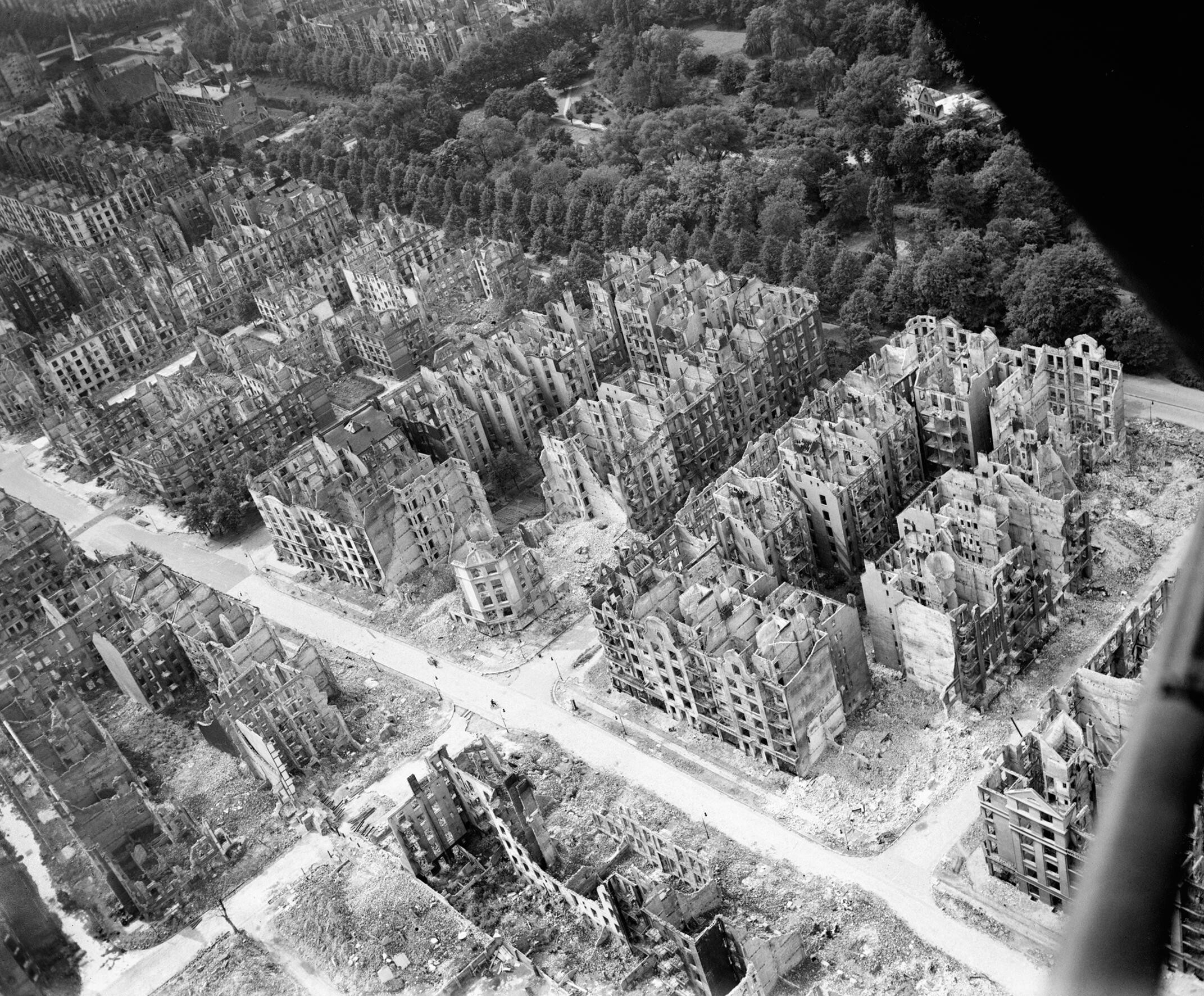
Hamburg after Allied bombing in WWII

The crime of genocide is based on an intent to destroy the target group “in whole or in part.” To a layman, that sounds like it doesn’t matter how much of the group is destroyed. But that is not how the courts have interpreted it. The “part” has to be a “quantitatively substantial part of the protected group,” as discussed at length on the Krsti? trial court opinion (https://ucr.irmct.org/LegalRef/CMSDocStore/Public/English/Judgement/NotIndexable/IT-9833/JUD20R0000020261.TIF at ¶¶ 581 et seq.). Killing off all of the men and boys in Srebrenica “effectively destroyed the community of the Bosnian Muslims in Srebrenica as such and eliminated all likelihood that it could ever re-establish itself on that territory.” (¶ 597). That level of death and destruction, evident in the smallest genocide ever adjudicated, has not occurred in Gaza.

The answer to all these arguments is ordinarily to try to say that it’s just “semantics.” But of course that is no answer when discussing criminal law, and certainly not when invoking the crime of crimes, as genocide has been called. A person who kills someone doesn’t want to be called a murderer if he is innocent because he was acting in self-defense, or guilty only of manslaughter because he didn’t have the specific intent to kill or didn’t premeditate the crime. The words matter. And if the word “genocide” doesn’t matter, then why won’t people just stop using it when they talk about Gaza? The truth is that the word does matter, and it matters a lot. If you really think that Israel is committing a genocide, then you should think that we should take military action to stop the genocide. And if you are calling for military action against another country, you had better be right.

What I object to, and find truly offensive, is the coopting of the term invented to describe the Holocaust, and the murder of dozens of my relatives, as a way of avoiding serious questions about culpability, about the legitimacy of wartime actions, and about a whole host of other things. I object to using a term that describes something quite different from what has transpired in Gaza. When I hear genocide, I think Treblinka. But Gaza is no Treblinka. (It also is no Theresienstadt, as I wrote back in 2012.)

In my view, there is at least one more serious question that will have to be addressed if there is ever a trial on genocide in Gaza, and that is the legitimacy of the military action. It is hard to justify the mass execution of prisoners, as occurred in the Holocaust or, on a much smaller scale, in Srebrenica, or the types of wanton mass slaughter seen in Rwanda. But civilian deaths incident to military strikes in a war zone are another thing altogether. When people speak of the number of people killed in Gaza, it is often as if they assume that zero people died as a result of legitimate military action. But that position is untenable. The Gaza war began with an invasion of Israel, the mass murder of about 1,200 people and the taking of hundreds of hostages. There is no court that is going to hold that Israel’s military retaliation and invasion of Gaza was completely unjustified as a matter of international law. So, whether the death toll was 70,000 or more, at least some percentage is going to have to be attributed to legitimate military operations. What is that number? It is not zero. It is going to be substantial. The next question then becomes, how many civilian deaths were the result of legitimate military action. Remember, Hamas in Gaza never surrendered. (Even the German and Japanese surrendered. What is wrong with these people?) By all accounts there was a large amount of fighting in civilian areas. If a Gazan sniper is firing on Israeli soldiers as they walk down the street, those soldiers are allowed to shoot back in self-defense. If it happens that children are in the apartment, or nearby, they could easily become victims. Who is to blame in that scenario? Not the soldiers. Those deaths are not a genocide. Mistakes are also not a genocide, and in war there are plenty of mistakes. There were 9-11,000 civilian deaths during the Battle of Mosul in 2016-17. No prosecution for genocide. Remember, the drafters of the genocide convention were largely unconcerned with mass killings during what they deemed legitimate military operations. I think it is highly unlikely that civilian deaths in Gaza will be considered any different from those seen in many other military campaigns. There never has been a genocide adjudicated as a result of a number of small incidents. It’s not enough even to point to a few hundred wrongful military actions, spaced out over time, where a small number of people are killed in each. If you want to look at a war that may be comparable to what has transpired over the past two decades in Gaza, see the Sri Lankan Civil War where deaths were estimated at 80-100,000, including about 40-70,000 civilians. Like with Gaza, some have called it a genocide (in one incident it is alleged that some 5,000 Tamil civilians were rounded up and executed), but no prosecution has occurred.

This is not to say there could not be individual war crimes prosecuted, but although everyone admits that possibility, it remains to be seen whether any valid claims will materialize. My issue is with the use of the extraordinary accusation of genocide. War crimes are much more common.

I believe that anti-Semitism is at the root of much of the noise we hear about genocide in Gaza. It’s just so easy to fall back into the old tropes. Jews have always played this role for the gentiles, representing whatever it is they most despise (as Dara Horn argues in her newest book). It manifests in an obsession with Israel and a willingness to believe every accusation against it, along with leaving all critical thinking aside when considering the role that Gazans are playing in the conflict. People like Mehdi Hasan, Zoran Mamdani and Abdul El-Sayed are without a doubt these types of anti-Semites. But there is a more subtle form of anti-Semitism that is indifferent to the fate of the Jews in Israel. It isn’t as if we cannot imagine Jews being slaughtered in large numbers. It has happened before. And it has happened again. So if you just don’t care what might happen to Jews, well, in my view that makes you an anti-Semite.

It is a bit harder to attach that label to the many Jews who so enjoy hurling the accusation of genocide against Israel. I don’t know if there is a causal nexus, but I have noticed that a good many of them have communism in their background. (See, for example, Norman Finkelstein or Ilan Pappé.) Jews, by insisting on their differences, have always been a thorn in the side of anyone dreaming of a utopia, whether left or right wing, because utopia requires that everyone thinks the same way and works towards the same goal. Jews are stubbornly individual and that makes them a problem. They don’t go with the flow. Any hint of exceptionalism rubs these particular anti-Israel Jews the wrong way, and that leads them to instinctively oppose Israel whenever possible.

Then there are the so-called “genocide scholars,” like the expat Israelis Omer Bartov and Raz Segal. Listen, I have read Bartov’s books. He knows a lot about what happened to Jews in Ukraine under the Nazis, that’s for sure. But I don’t get the sense that he understands as well the other side of the equation. In other words, he knows a lot about victims, but not as much about perpetrators. For Bartov, I like to invert a bit the old saying: “to the nail, everything looks like a hammer.” And there’s just no doubt that he has issues with Israel. What these scholars lack though, is a law degree. They speak of genocide in aesthetic terms, as if it’s only the photos of dead babies and angry statements of politicians that matter. The arguments they make on what is, in fact, a matter of law are mostly incoherent, when not misleading. Segal penned an accusation that Israel was committing genocide on October 13, 2023, at the outset of the war instigated just six days earlier by Gaza when it invaded Israel and began murdering and taking hostages. How can anyone take such a person seriously? Bartov was a bit slower to make the case for calling Israel’s actions a genocide, not until July 15, 2025. But he did so by avoiding and changing the legal definition. He doesn’t grapple with the issues I addressed above. Because they are hard to grapple with if you want to make a case against Israel. I don’t think that Bartov is an anti-Semite. I don’t think he doesn’t care about the fate of half the world’s Jews in Israel. But I do think he is not being honest in his assessment of the situation. It may be a case of him just wanting to sit with the cool kids in the faculty lounge at Brown University or be invited to speak at other venues rather than be ostracized. (He certainly has made the rounds since his conversion to the Israel genocide cause.) Or it may be that he sees this as a chance to needle Israel, a result of trauma from his service in the Yom Kippur war and resulting disillusionment. I don’t know. All I know, as someone who also knows his way around the subject of genocide and can read and understand legal materials better than most, is that he is almost certainly wrong in his conclusion and that his arguments are to me very unpersuasive.

The most thorough attempt to prove genocide that I have seen is the May 2024 Analysis prepared by the University Network for Human Rights. Most of it is simply saying that a lot of people were killed, which, as I already explained above, is not persuasive since the numbers are neither as substantial as any prior genocide, nor conducted in the manner that those genocides occurred. To me, the weakness of the argument is underscored by the attempts to bring in a whole host of smaller accusations that have little or no bearing on the genocide case (¶ 146 (desecrating cemeteries) or ¶ 84 (degrading treatment) for example). And when you drill down and check the legal work, it doesn’t hold up. One example picked at random: paragraph 176 argues that “Under customary international law, ‘all feasible precautions must be taken to avoid, and in any event to minimize, incidental loss of civilian life.’” In support of this proposition, footnote 607 refers to Rule 15, Principle of Precautions in Attack, ICRC (which is persuasive, but not necessarily binding authority for international law). The discussed source for the ICRC rule refers to military attacks on “undefended” towns and ports, and refers to its application in the Kupreški? case, concerning a Croatian army massacre of Muslims. If you read paragraphs 762-764 of the case, you can see what they are referring to was not a regular military operation, but a pogrom. (“Nor does the concept of a military combat engagement accord with the fact that the houses of Muslim civilians were broken into and the male members of military age pulled out and executed. Above all the intentional killing of children, at least one of which was only three months old, cannot be reconciled with the view that this was an action demanded and guided by strategic or tactical necessities . In sum, the damage and harm inflicted by the Croats on the Muslim civilian population was not collateral; it was the primary purpose of the attack.”)

For me, perhaps the hardest to respond to is the interview that Philippe Sands gave with Ezra Klein. I know and greatly respect Sands. He is an accomplished lawyer and author and knows more than I do about the subject. He has argued genocide cases before international courts, which I have not done. He gave an interview with Ezra Klein in August 2025 where he discussed the legal issues in prosecuting genocide, pointing out that the bar has been set very high in the cases of Rwanda and Srebrenica. He doesn’t enjoy the legal wrangling over the term, believing that war crimes of all types are just as significant as genocide. He does not like the legal standard that has been applied to genocide (he lost the case he was arguing on behalf of Croatia, and is arguing another case now against Myanmar on behalf of the Rohingya) because it makes it difficult or impossible to convict for genocide if there is more than one intention, for example, not only genocidal but also self-defense. He’s right that there’s great difficulty in proving a singular intent, but I am not sure he is correct that the requirement is wrong. Let’s say The Last of the Mohicans is rushing at you with an axe intending to murder you. If you shoot to kill him, you are clearly intending to destroy his entire tribe (he is the last of them, after all) but you are also acting in self-defense. Are you guilty of genocide? I don’t think so. Self-defense has to be permitted, as it is a part of human nature. The question is whether the belief that you need to act in self-defense is reasonable and therefore recognized as legitimate. Even an unreasonable, but honest, belief in the need to act in self-defense (called an “imperfect self-defense“) can mitigate a crime. Every genocidal maniac believes he is acting in self-defense. The Nazis believed they needed to kill all the Jews to save Germany. So the question is not whether there is an alternative intent. The question is whether that intent is considered legitimate under the law. That determination is going to depend a lot, I believe, on military analysis, something that neither I, nor any of the “genocide scholars” have much experience with. For my part, I haven’t seen evidence that Israel’s actions in Gaza were not based on a reasonable belief that the actions were necessary for self-defense or rescue of hostages.

When Klein was interviewing Sands, the current talking point against Israel was that it was engineering a massive famine in Gaza. That clearly influenced both of them. It also turned out to be wrong, as the number of deaths from hunger finally claimed by the Palestinian Health Ministry was less than 500. And it also cannot be said that Israel was in fact responsible for the lack of food, with reports of Hamas looting and hoarding of food supplies as a means of controlling the population. Still, the allegations were enough for Sands to be certain that war crimes were being committed. On the question of genocide, Sands admitted that the judges of the genocide case will have to weigh Israel’s claims of self-defense as a justification. He wasn’t certain if the judges would follow the precedent of the previous genocide cases or “reduce the bar and conclude that this is a genocide.” A further complication is that the case against Israel, as with the one Sands himself is prosecuting against Myanmar, the defendant is the country, not an individual, and no court has previously held a country guilty of genocide.

Where I depart from Sands is his apparent assumption that Rafael Lemkin would have concluded that Israel was committing genocide. Sands doesn’t actually say that, he says that Lemkin “would certainly characterize what is happening now in Gaza as genocidal.” Bartov also uses this type of semantic dodge. The adjective genocidal, of course, is not the same as the noun genocide, just as murderous is not murder. Sands believes that Lemkin’s definition of genocide was in some sense broader than the legal definition ultimately adopted and currently applied. In Sands’ view, Lemkin would not have required large numbers to be killed, nor did he require specific intent. I’m not sure that is correct, but let’s assume that Sands is right. It still doesn’t answer the self-defense question. I doubt that Lemkin would have felt any different from Ben Ferencz, who prosecuted the Nuremberg trials. In response to the defense argument that the Allied bombing of Dresden and Hiroshima establish that humanitarian rules did not apply, Ferencz responded “He did not seem to notice that it was the one who struck the first blow who should expect legal retaliation.”
Rebuilding in Malibu

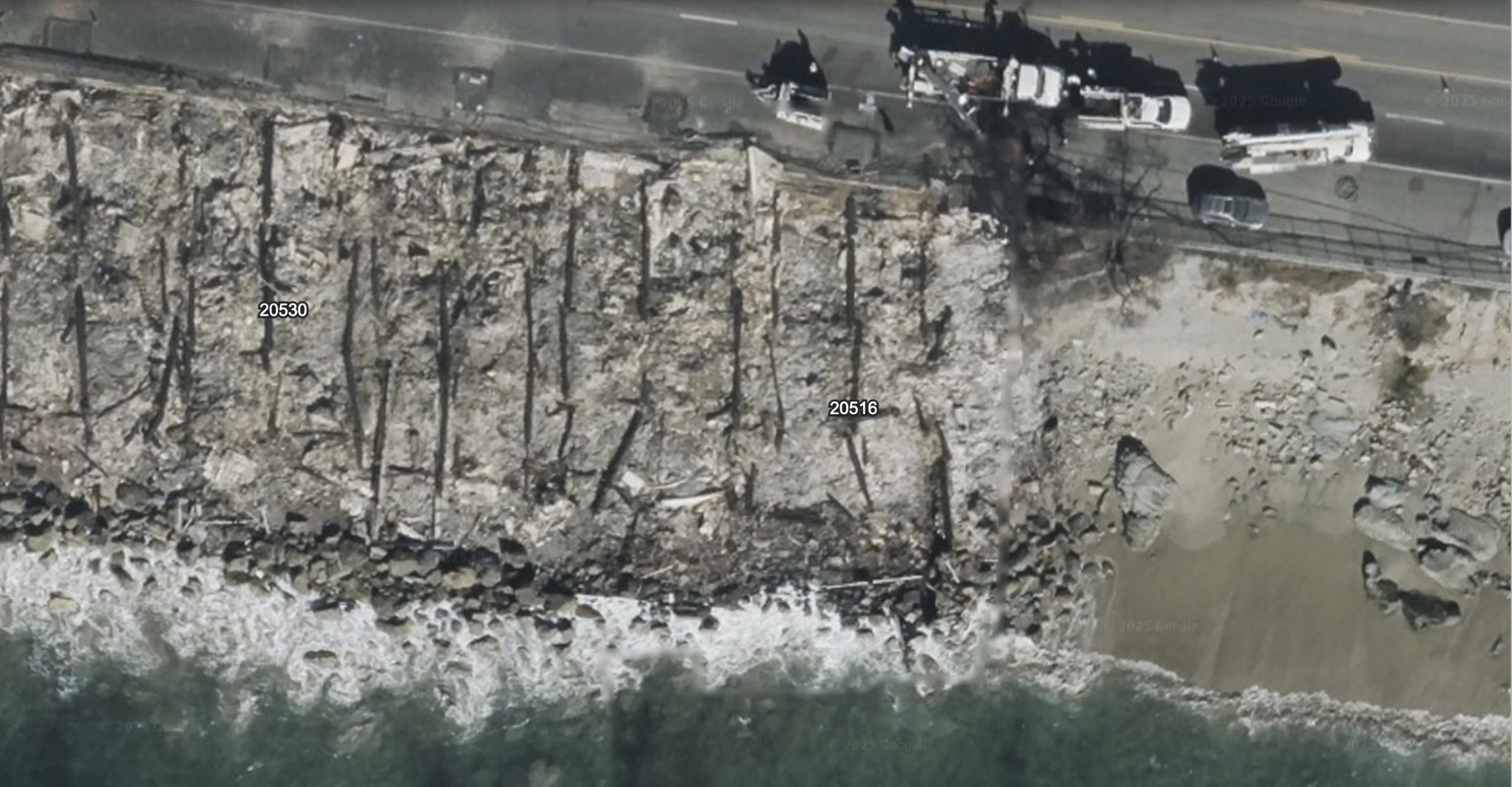
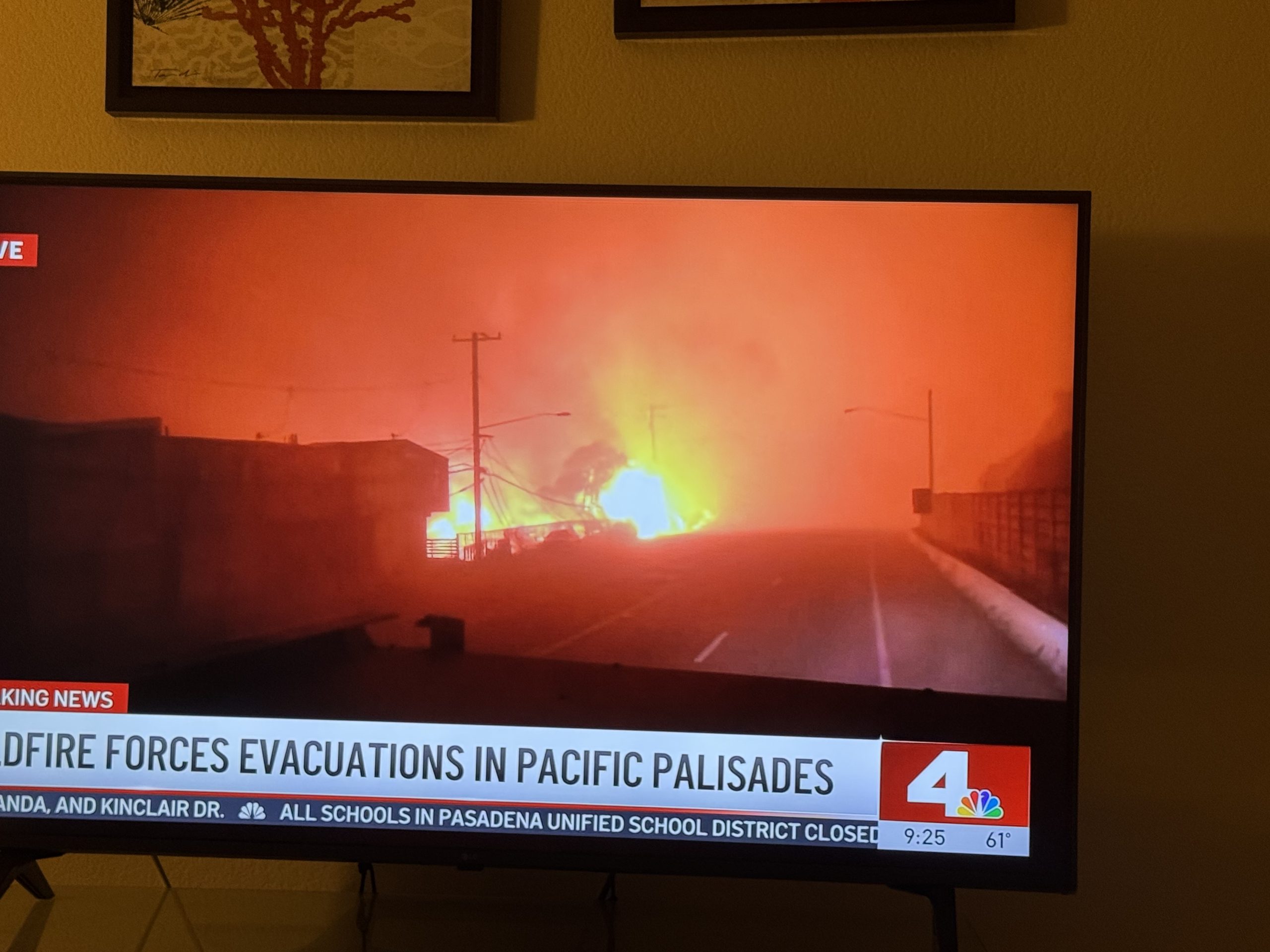
Our home in Malibu burned down on January 7, 2025. Already that evening I received a photo of the Channel 4 news showing our home as a ball of fire. It was several weeks before I could focus on the question of whether we would rebuild. In February, I asked a friend and neighbor who is a builder, and had lost a home he was building in the Palisades, to start designing and planning the new home.

But first, I needed to know whether we would receive our insurance money. On February 10, I received an email saying our claim was approved. We did not receive any funds until a small partial payment came on March 11. Further funds came on March 19. At that point, I was confident we would have the funds to rebuild, if we wanted to. We decided to pay our builder friend for the work he had done, and on March 21 we hired another friend who is an architect to manage our project.

As of that time, our lot and most of the Palisades and Malibu was still filled with debris. I had gone through weeks of stress getting the paperwork approved so that our lot could be cleared. Our first online submission disappeared. A second submission made in person at the recovery center on Pico also got lost. I sent an email follow-up and someone at LAPW found it and called me. I sent him again all of the paperwork, called him back repeatedly, but still no success. Finally, I submitted online again, and suddenly we got through the process, much later than most of the other victims. Nevertheless, or maybe because of these problems, we were among the very first to have our lot cleared, and on March 25 it was done.

On February 28 I retained a licensed surveyor I had used previously to do a new survey for our property. Getting down to Malibu at that time was not easy, and the surveyor needed the lot cleared. The surveyor didn’t get a preliminary survey done until April 22, and it had some issues that needed correction. Unfortunately, she refused to complete the work and, even though she promised to reverse the charges, I had to get them reversed by American Express. On June 25, we hired another surveyor and he completed the work on July 28. We still need some markers placed on the border (because the lot line is not easy to find and is not perpendicular to PCH), but that hasn’t been completed as of August 24. So, six months after hiring a surveyor we aren’t even finished with that process.

When I first visited the Malibu Rebuild Center on February 19, everyone was very friendly. I had emailed for an appointment and got a very quick invitation to come down. At that time, PCH and Topanga Canyon were both still closed, so the only way to get to Malibu from Brentwood was through the Valley, with a nice, but long, drive through Malibu Canyon. I met with several people, and Lauren Doyel gave me lots of advice, including that we’d have to remove our two septic tanks and replace them with a new advanced onsite wastewater treatment system surrounded by a very expensive new sea wall. The costs would likely be hundreds of thousands of dollars, and this before we even got to the foundation of the new home. At that time, we were still uncertain of our insurance recovery. I was questioning whether the funds would be sufficient to rebuild if we had to spend so much just to replace the septic tanks. Ultimately, I stopped trying to calculate whether it made economic sense to rebuild. There were too many moving parts (including a separate insurance payment we get only if we do in fact rebuild). When we hired our architect, I decided that we should rebuild even if we had to invest even more money in the house. That decision relieved lots of my stress and anxiety. I told people I had gone through various stages of grief and was finally at acceptance.

After Lauren Doyel’s advice that we would not be able to keep our old septic tanks, I decided to make sure. So when the lot was cleared, I immediately hired someone to inspect the tanks. The inspection came back and said the tanks were destroyed and needed to be removed. So I hired another company to remove them, using a recommendation of a local contractor from a neighborhood Whatsapp group I had joined on March 2 after one of our neighbors found me. I also needed this contractor to clear some debris that had fallen from our home onto the neighboring beach operated by the MRCA. On April 17, after finally getting permission from MRCA, the contractor sent people to clean the remaining debris and remove the septic tanks and we discovered that the initial inspector I had paid did not even visit the property before submitting a report saying the tanks were destroyed. The tanks were still buried. They dug them up. One was in good shape, and the other needed repairs. I decided to bite the bullet and have them both removed, following Lauren Doyel’s advice. There had already been discussions in Malibu about installing a sewer line, but I had no confidence that it would ever happen, and was sure that it wouldn’t be completed for many years, likely beyond the six year time frame to rebuild the house without interference from the coastal commission under the governor’s order. The initial time estimate announced at a Malibu town meeting was 65 months, and that did not include the time needed to give the green light on the project (i.e. all of the various council meetings, and presumably an election to approve a bond measure). The septic tanks were removed on April 28.

After a number of meetings with our architect, on June 6 they submitted plans for a preliminary review by Malibu Planning. We had to get notarized signatures on a form authorizing our architect to submit the plans. (Despite this, every official communication from Malibu Planning goes only to us, and not to our architect, so I have to catch the email and forward it to my architect. No idea why that is.) Our coastal pre-screen report from Lauren Doyel came back with comments on July 18 (42 days, if you’re counting). All of the notes were negligible, and there was one glaring error on their part where they for some reason thought we were rebuilding a duplex even though we had done a formal lot merger in 2007-8. We had a zoom meeting with Lauren on August 1. The plans were corrected and resubmitted on August 13. As of today (12 days), we haven’t received a response.

We’ve been proactive as we can be in trying to hire experts. On May 19 we hired a coastal engineer experienced with Malibu to do a wave uprush study, a necessary report for any rebuild on the beach. Our architect has been prodding her to finish, but despite many promises, we didn’t receive the 2-page preliminary wave uprush report until August 22, over three months later. The final report was supposed to be sent this weekend but I haven’t seen it. Our coastal engineer thought we might not need to build an expensive sea wall around our septic tanks if we can rebuild the rock revetment in front of our tract. On Friday she said that the plan for our septic tanks was “too far” back from the coastline and we might still need a sea wall, which makes no sense to me. The issue is that the septic must be as far as possible from the coast and because we now have a double-lot, our tank can be be wider than it was, and not as long, and therefore a few feet closer to PCH and away from the coastline than it was previously. Why we should be penalized for that, I have no idea. But in any case, it’s time to repair the rock revetment protecting our whole tract, with the hope that this will obviate the need for an expensive sea wall. That revetment repair will require coordination among all the neighbors. I have been doing research for some time, even went to the Coastal Commission offices in Ventura to scan old applications and maps from previous repairs of the revetment which took place in the early 2000s before we bought our home. I spoke with the contractor/expeditor who removed our septic tanks, and he wants to work on the project. He said that last time it took a full year to get the repairs done. I am hoping we can do it much faster this time, hopefully without the need to go to the Coastal Commission. Not sure why getting permission to put the big boulders back where they were before they fell down towards the ocean would be such an ordeal, but this is how things work (or don’t work) on the coast.

Another expert we hired is our soils engineer. We hired them on May 15, based on their estimate of two weeks for excavations and another six weeks for a report. They did not visit the lot until June 23 (five weeks), and then realized that they could not get their boring drill onto the property because of the telephone lines. All but one of the houses in our tract had been cleared but they needed the last one cleared in order to get to our lot from the other side. That lot was cleared a few days later on June 26, but the drilling company did not return until July 9 when they successfully drilled two holes in the soil down to the bedrock. The full report arrived August 21, over three months from when we hired them.

The wave uprush study and soils report are necessary before our septic engineer can plan the new septic tanks, and the structural engineers can begin working on a plan for the foundation and support of the new home. Now that we finally have those in hand, they can begin work. So that’s where we are at the moment. If we have to wait for the revetment repair before the plans can be finalized this may delay our entire project for a long time. Getting all of the neighbors in our tract to sign off on the revetment repair is going to be a chore. Several of them are working on their rebuild, but another bunch are stuck. Some have land leases, which puts them in a similar position to mobile home residents. The property ownership is divided and so it doesn’t necessarily make economic sense for the home owner/tenant to spend his insurance money on a new home that he won’t end up owning at the end of the lease. The long-term lease is now a liability, not an asset, as they are required to pay rent for an empty lot that cannot be used. So these people are stuck in limbo. But in our tract, we’re tied together with our common walkways and rock revetment. So we need their cooperation. It’s going to be a struggle.

On my initial trips to the rebuild center I tried to get a handle on some of the issues that I could foresee. The people there were always very nice, but often I could not get definitive answers. Basically, each of the six sides of the box that is our lot has an issue. The easiest side is actually the beach side, where there is a string-line rule that says we need to rebuild our deck in exactly the same spot. On the east border with the beach operated by MRCA, beyond the issue of finding the corner and drawing the non-perpendicular line out from PCH, we have to calculate where we can build our stairs, which may have to be different from what we had before because of the new concrete pylons replacing our wood ones and new code rules on staircases. The access onto the beach over some of the boulders is also a bit tricky (there were some steps there on the MRCA side of the property but those seem to have been removed during the debris removal, and MRCA isn’t easy to deal with, to say the least — see my old blog about correcting their disastrous beach renovation project). On the north border with PCH there is the fact that the retaining wall for PCH has issues and needs to be repaired. On the west border, we (like all the others in our tract) had a narrow walkway between our garage and our neighbor’s garage, not to current code. I took several trips down to the rebuild center before speaking to the fire department and getting a verbal confirmation that we could build with the same narrow width (4 foot total, 2 on our side and 2 on the neighbor’s side), which is far less than the ordinary 10% setback would be for our lot, now that it is combined and is 43 feet wide. I hope that remains true after we submit plans. Building out the common walkway, with an easement onto our neighbor’s property, will require cooperation with the neighbor. But he has been mostly incommunicado and has said he might not rebuild. How can we build a common walkway and stairs if the neighbor won’t agree? The rebuild center didn’t have an answer for that. I said six sides because we also need to know the top and bottom. We can build up to 110% of the prior height. How tall was our home? No one seems to know and none of our old plans has that dimension. The limit is 24 feet for a flat roof and 28 for a pitched roof in Malibu. Can we build up to 24 feet? Who knows? I asked about whether we could have a roof deck, since one of our neighbors in the tract did have one. No good answers. It’s complicated, even though there are no view issues since there’s a huge mountain hillside going way up to the Big Rock area on the other side of PCH. And then there is the bottom. We need to be above the FEMA limit which is 19 feet elevation in our area. Our house was at 21 feet so we should be good. Then our coastal engineer said she thought we might need to a bit higher than 21 feet because of the wave uprush study. More complicated. If you need to raise the house up because of FEMA you can do that, and not lose height, but they don’t have a rule that allows you to raise the level because of the wave uprush study. Turns out now the coastal engineer thinks we might not need to raise the level after all. But, not easy to build a house on a small lot if every single dimension is uncertain. And did I mention that we didn’t even know how wide our property was? It’s shaped like a parallelogram, but until we had the survey finished we weren’t sure about the angles and couldn’t calculate the width between the east and west boundaries. Fun, fun, fun.

One other issue to mention, there’s a new program to refund building fees for Malibu residents. Apparently we don’t qualify because it was our second home. When another person in the same boat asked why, the response was that it was to make sure developers paid fees. But there are a bunch of us who are not developers, just part-time residents. I sympathize with the need for Malibu to collect fees to cover all the expenses of running the rebuild center, so I’m not too upset. But I don’t like being lumped in with speculators and developers when they try to justify the discrimination against non-residents. We never even rented our home, so Malibu’s been getting a pretty good deal from us, lots of taxes paid and very little demand on services.

So those are the issues at the moment, at least the ones I am focused on. How long will the rebuild take? It’s anyone’s guess at this stage. How much will it cost? Again, no idea. This isn’t how you normally build a home. We built our home in Brentwood Glen in 2004-5 and it took about 18 months. This time won’t be as easy.

Czech it out, I’m now Czech!

Last summer I succeeded in gaining Czech citizenship, my fourth one after US, Austrian and German. The process wasn’t easy and so I thought it would be helpful to record it in this blog. One of the reasons I try to get all these citizenships is to find a path that perhaps others can use, so I hope this helps. If nothing else, it’s a good record of all of the issues and the documents I was able to find.

On September 6, 2019 the new Czech Citizenship Law went into effect, allowing descendants of former Czech citizens to obtain Czech citizenship. Similar laws were enacted in Austria and Germany around the same time, directed at descendants of Nazi victims. I had already obtained Austrian citizenship in 2014 under a different law that allowed children of Austrian mothers to obtain citizenship (which had formerly been impossible under an old sexist law).

I first made an inquiry regarding Czech citizenship in November 2019, inspired by a nice trip to Prague where I was able to research my ancestry back into the 16th century. The local Czech Embassy in Los Angeles responded promptly with a laundry-list of items I needed for my application. These included apostilled birth and marriage certificate for myself, my parents and grandparents, all translated into Czech. An apostille is an official certification from a government office that an official signature on a document is an authentic. In order to get one, you have to first obtain a certified original document, then send that original to the agency that issues the apostille. The Czechs also asked for a “document that certifies the date and the basis on which declarant’s grandparent ceased to be Czech/Czechoslovak citizen (e. g. US Naturalization Certificate).”

Initially I did not rush to apply. But when the pandemic hit in 2020, and my cousins began to be interested in getting another citizenship, I decided to take a closer look and started collecting documents for them and for me. During that first summer of lockdowns, I was able to travel to Vienna with my two sons, using the Austrian passports we obtained in 2014. Without these passports, we couldn’t have entered Austria at that time. We left our son Nathan to study in Vienna and I asked him to help me gather some of the documents we needed.

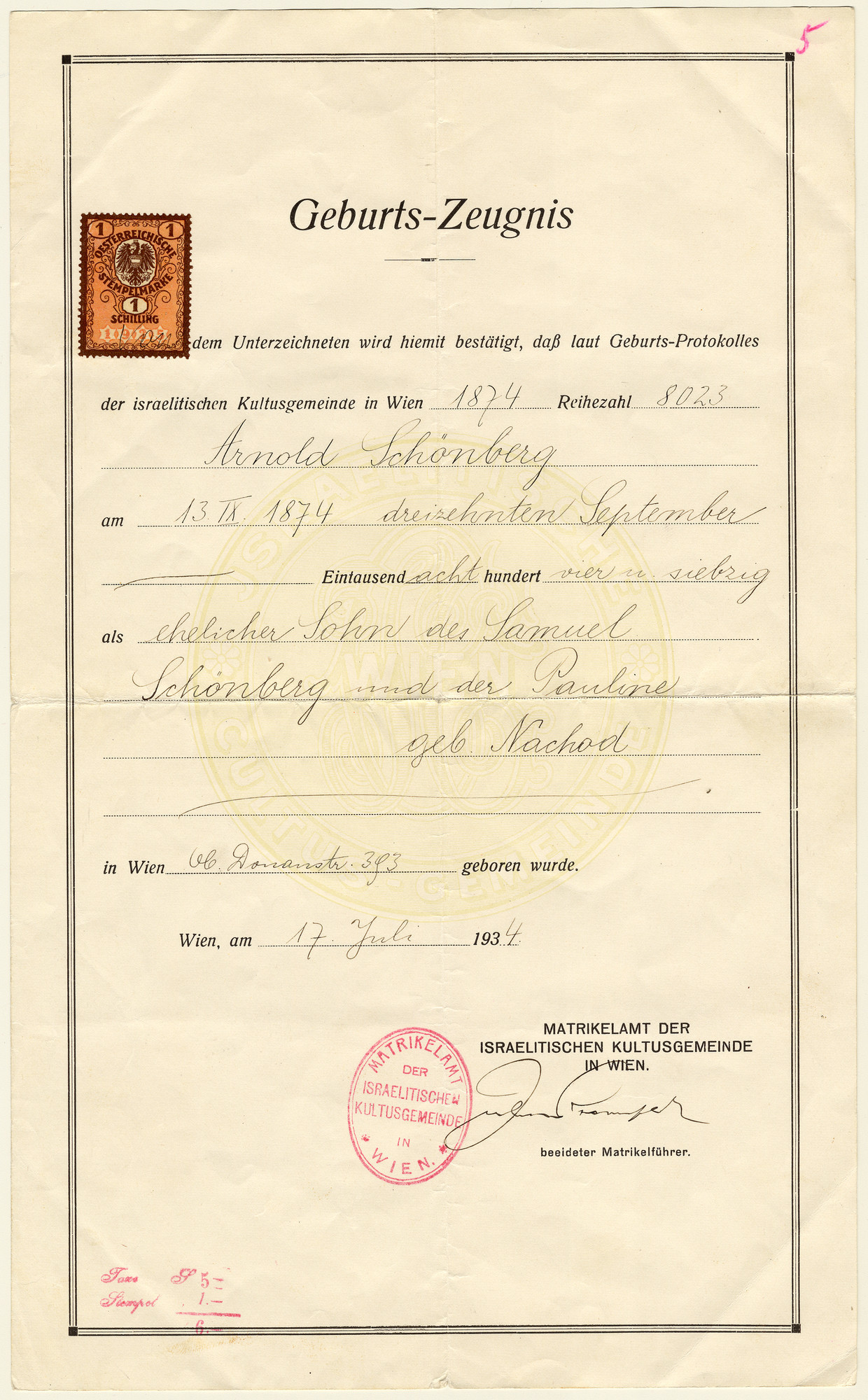
All of the original documents for my paternal grandparents Arnold Schoenberg and Gertrud Kolisch are kept at the Arnold Schönberg Center in Vienna. The archivists Therese Muxeneder and Eike Fess were able to find most of what we needed for my grandfather in the initial application, but then we needed to make certified copies and then bring them to the authorities to get an apostille for the Czechs. That wasn’t so easy. For my grandfather’s birth certificate, Nathan first had to go to the Vienna Jewish Community, which then directed him to an office at the City of Vienna for the apostille. At first the City official told Nathan he could not issue an apostille for the Jewish documents, but after Nathan called the person at the Jewish community who had sent him, the City official changed his mind and issued the required apostille. An important lesson: don’t take no for an answer.

Arnold Schoenberg Birth Certificate copy issued July 17, 1934

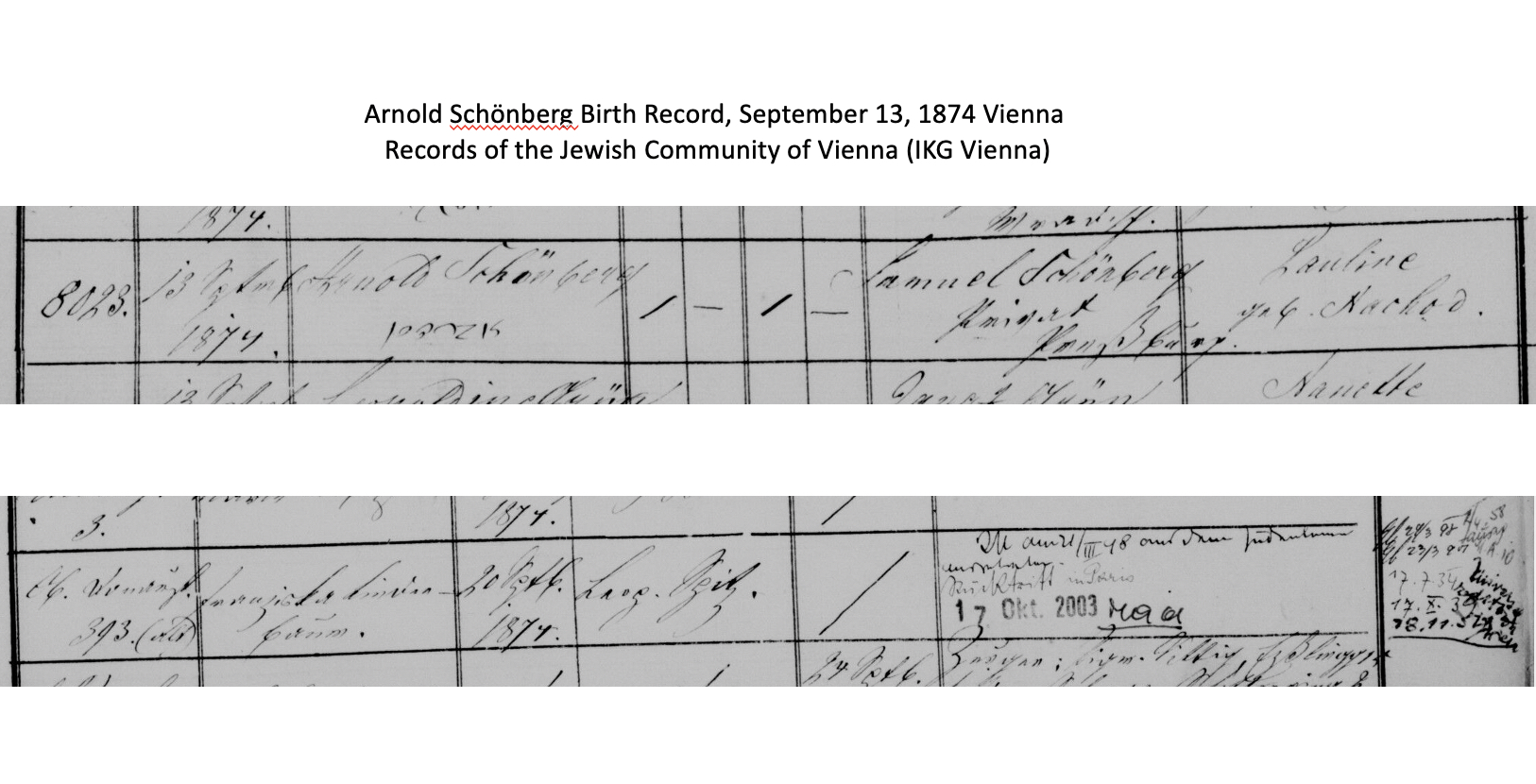
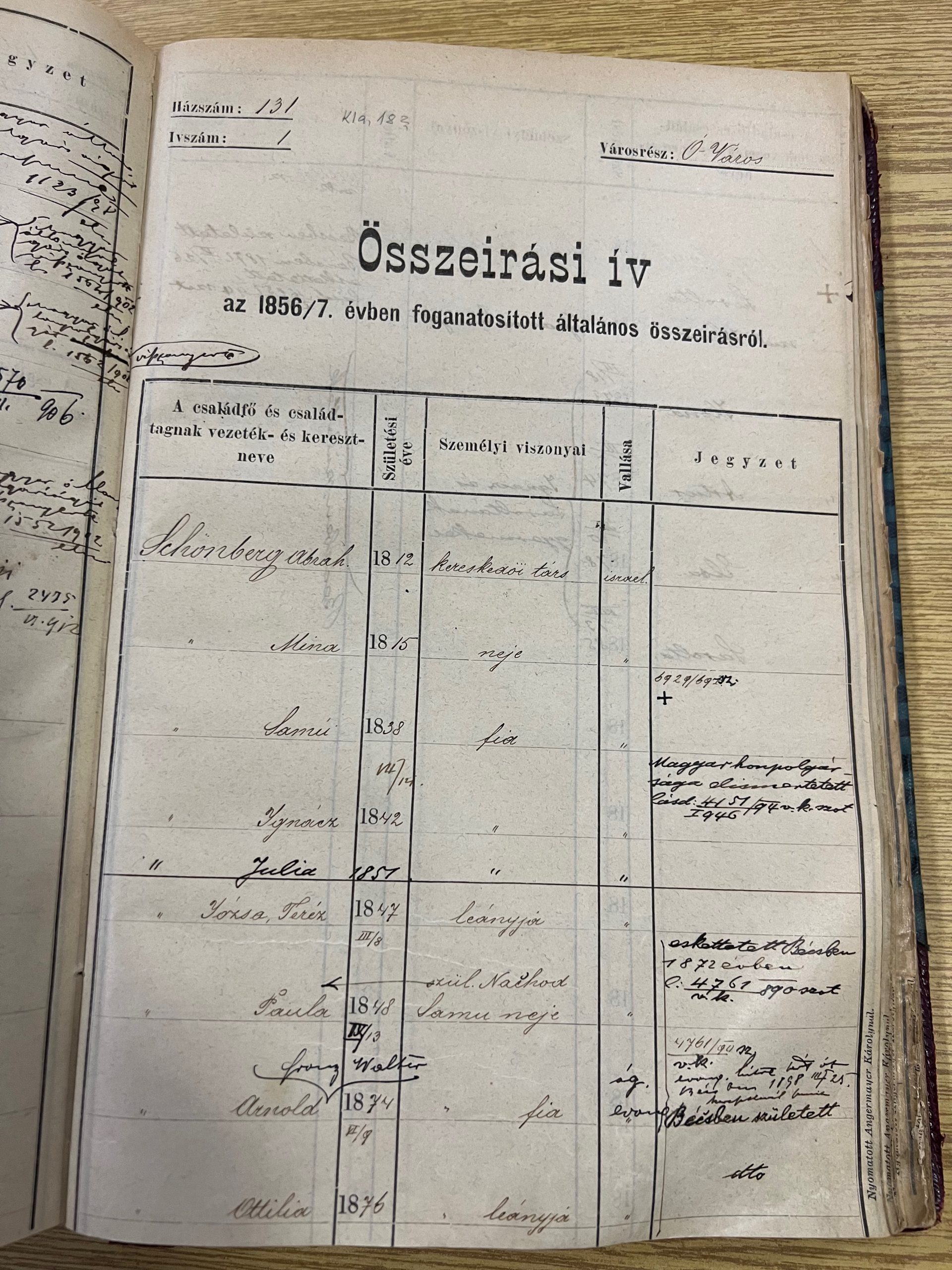
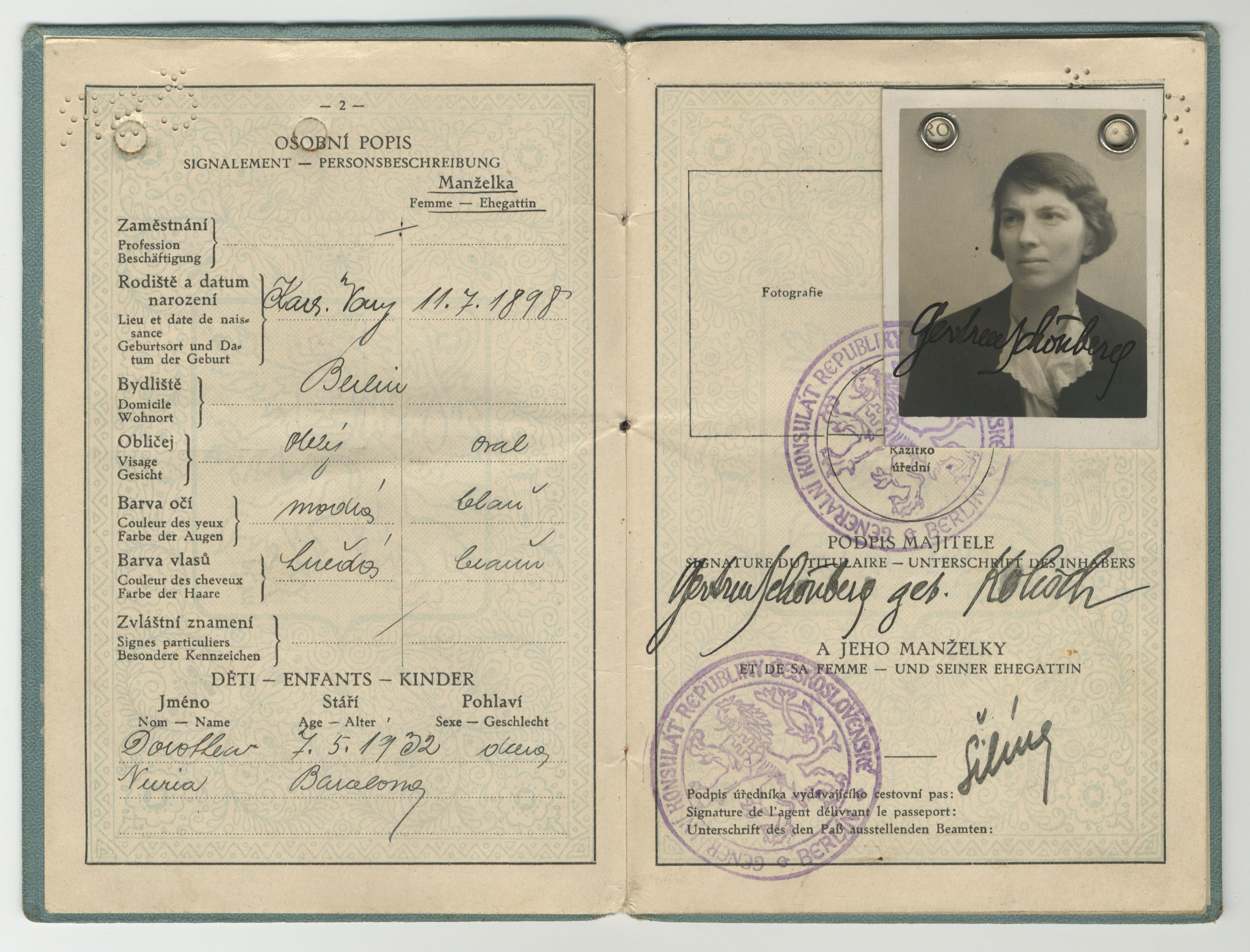
The archivists also sent me copies of the passports they had found in the archives and so I learned that my grandparents had German passports, as well as Czechoslovakian ones, but not Austrian passports. A scholarly article by Prof. Hartmut Krones from 2017 (Arnold Schönberg als „Kind“ Österreich-Ungarns) examined my grandfather’s citizenship in detail and provided an excellent guide to understanding his rather unusual situation. My grandfather Arnold Schoenberg was born in Vienna, Austria on September 13, 1874. At that time (and today) Austrian citizenship is not determined by the location of birth, but rather on the citizenship rights of the parents (back then just the father counted). Arnold’s father Samuel Schönberg had been born in 1843 in Szécsény, Hungary (then part of the Hapsburg’s Austro-Hungarian Empire), but by 1848, the family was living in Pressburg (now called Bratislava, the capital of Slovakia). Pressburg (in German) or Pozsony (in Hungarian), a city just one hour by train from Vienna, was the Habsburg capital for the entire Hungarian Kingdom, a part of the Austro-Hungarian Empire. In 1856/7, a Hungarian census form registered the family in Pressburg. I had obtained that document in 2004 as part of my genealogical research. When Arnold was born in Vienna in 1874, his birth was registered in the Vienna Jewish community birth record book, but his name was also added to that family census form in Pressburg. As far as Austria was concerned, Arnold Schoenberg’s citizenship was based on his “home right” (Heimatrecht) in Pressburg. Under his father Samuel’s name on his Vienna birth record it states “Preßburg.”

Pressburg census 1856/7 form registering Arnold’s birth in 1874

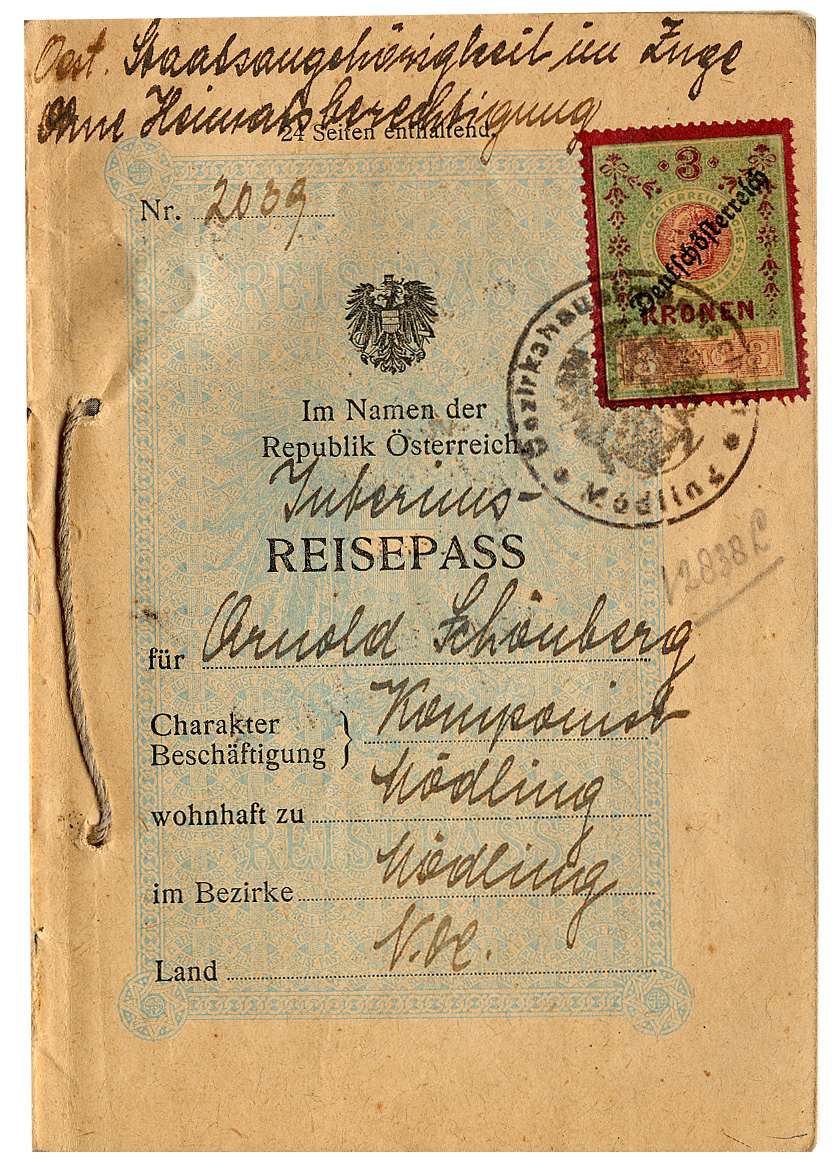
Of course, the location of his home right hardly mattered at the time Arnold was born. But things changed during World War I. Arnold had been registered to a Hungarian military unit based on his home right in Pressburg, and was then called up to a Hungarian battalion. Luckily, he was not sent to the front (he was over 40 years old). When the war ended, Austria-Hungary was broken into pieces by the Allies. Austria itself became a small alpine republic and from the ashes of the old empire a number of different states arose, including of course Hungary, but also Czechoslovakia, Suddenly, Arnold Schoenberg with home right in Bratislava was considered to be Czechoslovakian. Still, in 1920, he was able to obtain an interim passport from Austria. On the top it says his Austrian citizenship application was in process.

Arnold Schoenberg’s Interim Austrian Passport issued 1920

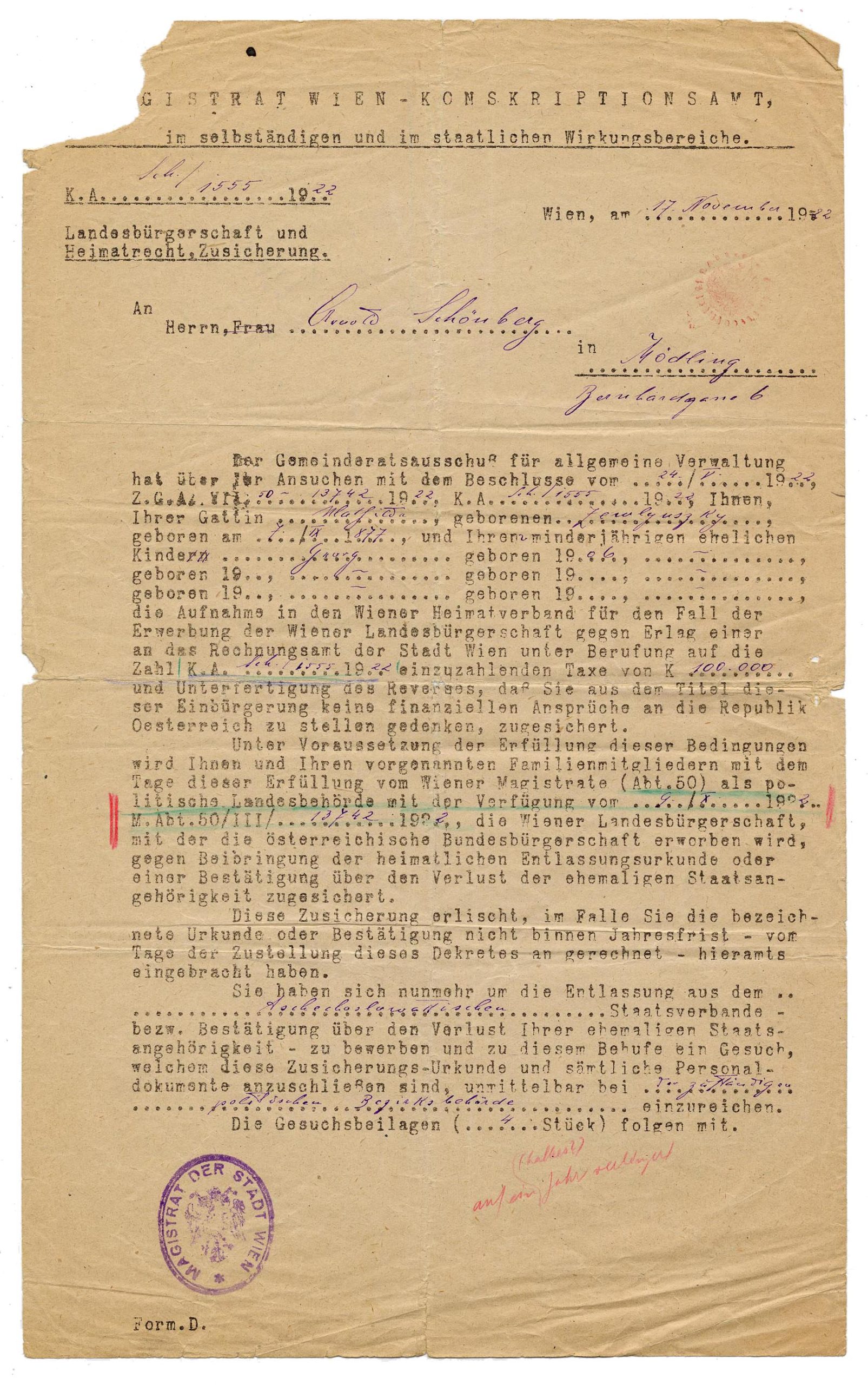
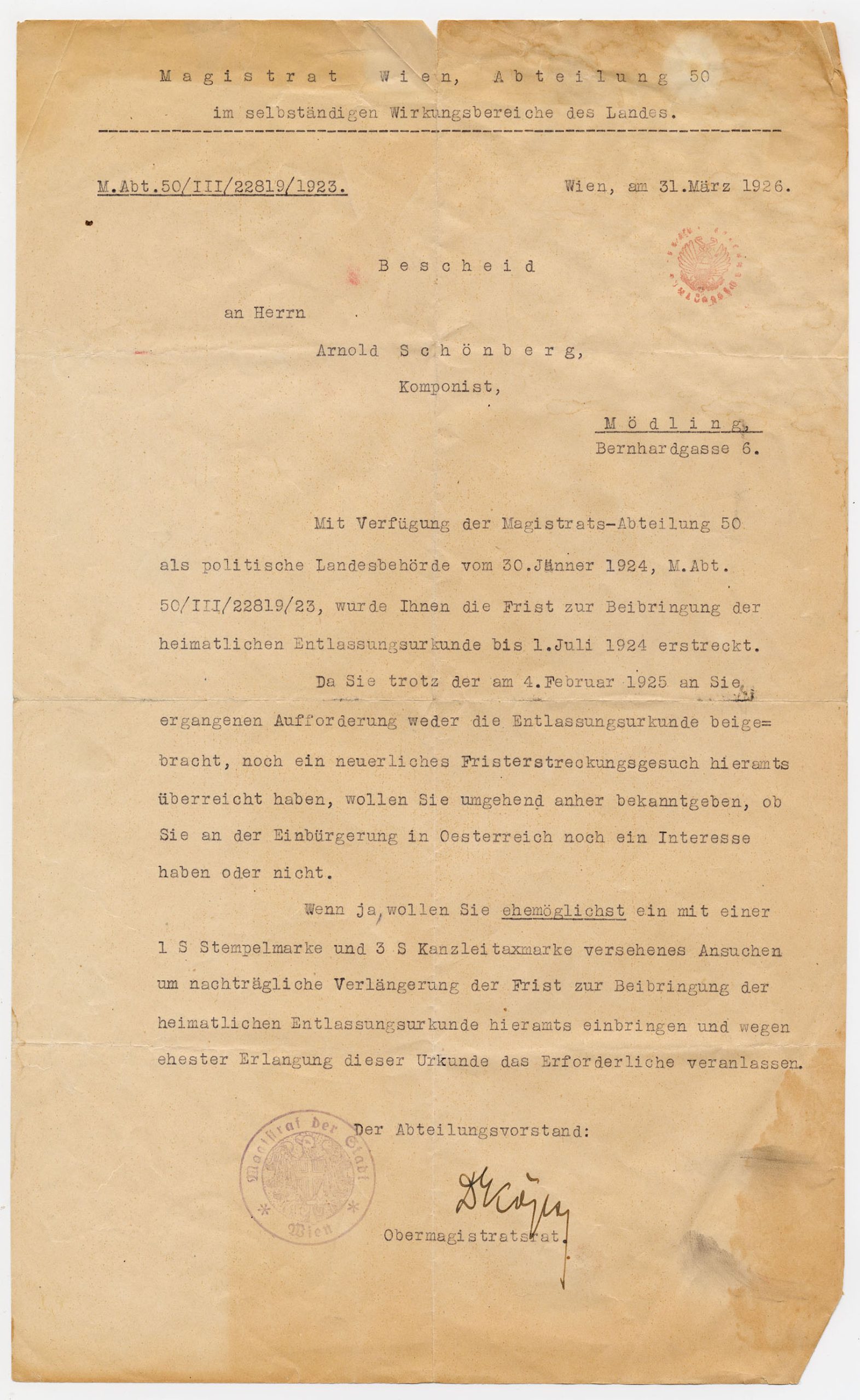
Under the treaties that ended the war — the 1919 Treaty of Saint-Germain-en-Laye and the 1920 Treaty of Trianon — citizens of certain parts of the old empire were given an opportunity to obtain Austrian citizenship. For whatever reason, Arnold Schoenberg missed the deadline to complete his application. Subsequently, the Austrians required a statement from Czechoslovakia that he had lost his citizenship or would be released from Czechoslovakian citizenship. None was forthcoming. As a result, he was stuck being a Czechoslovakian, and his attempts to rectify the situation and become an Austrian were unsuccessful. Of course, he had never lived in Czechoslovakia and did not speak the Czech or Slovak languages. Nevertheless, he was now a Czechoslovakian. Or so it seems. We have not found any document from that period confirming his new citizenship. Still, that should have been his situation at the time.

November 17, 1922 form concerning Arnold Schoenberg’s pending Austrian citizenship application, requesting confirmation of release or loss of Czechoslovakian citizenship
March 31, 1926 letter from the Vienna citizenship office to Arnold Schoenberg asking if he still wished to pursue Austrian citizenship, noting that he had not succeeded in obtaining a release of citizenship from Czechoslovakia.

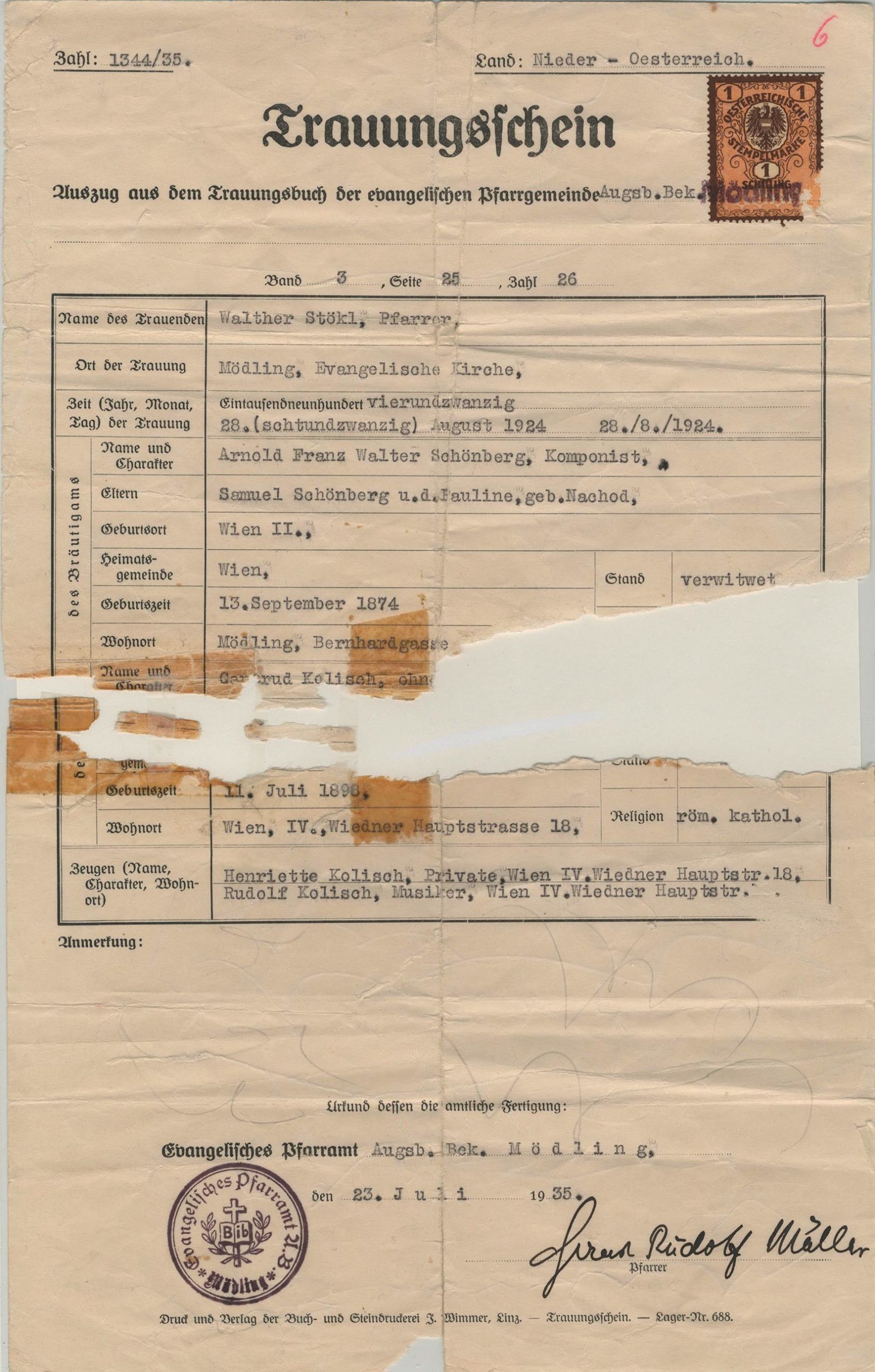
Before he could work out any other arrangement, Arnold married my grandmother Gertrud Kolisch in August 1924. (His first wife, Mathilde Zemlinsky had died in 1923.) Under the law at that time, the wife automatically obtained the husband’s citizenship, so after marriage, my grandmother was also presumably Czechoslovakian. However, there is no record confirming her status.

Marriage Certificate of Arnold Schoenberg and Gertrud Kolisch August 28, 1924, dated July 23 1935

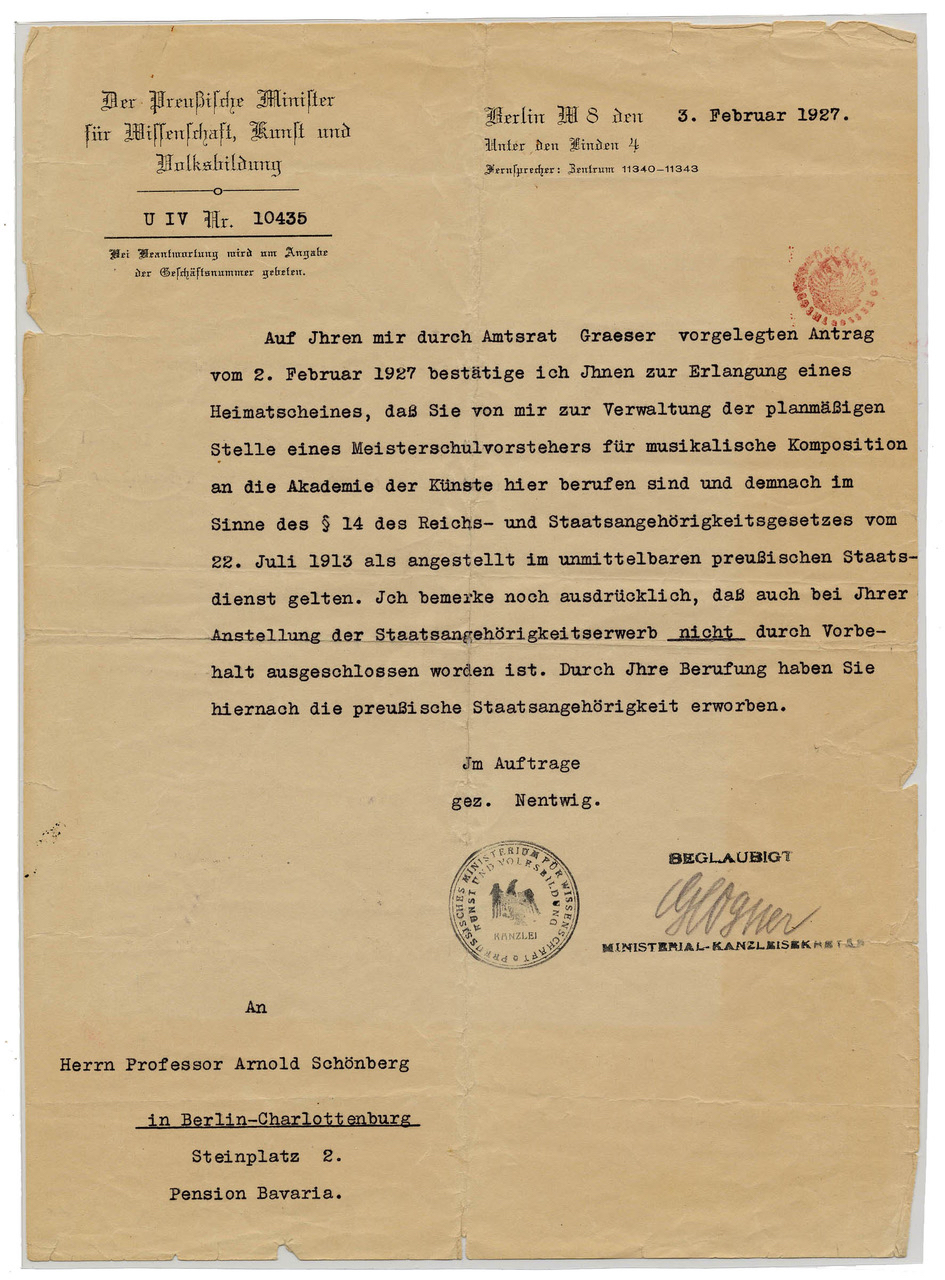
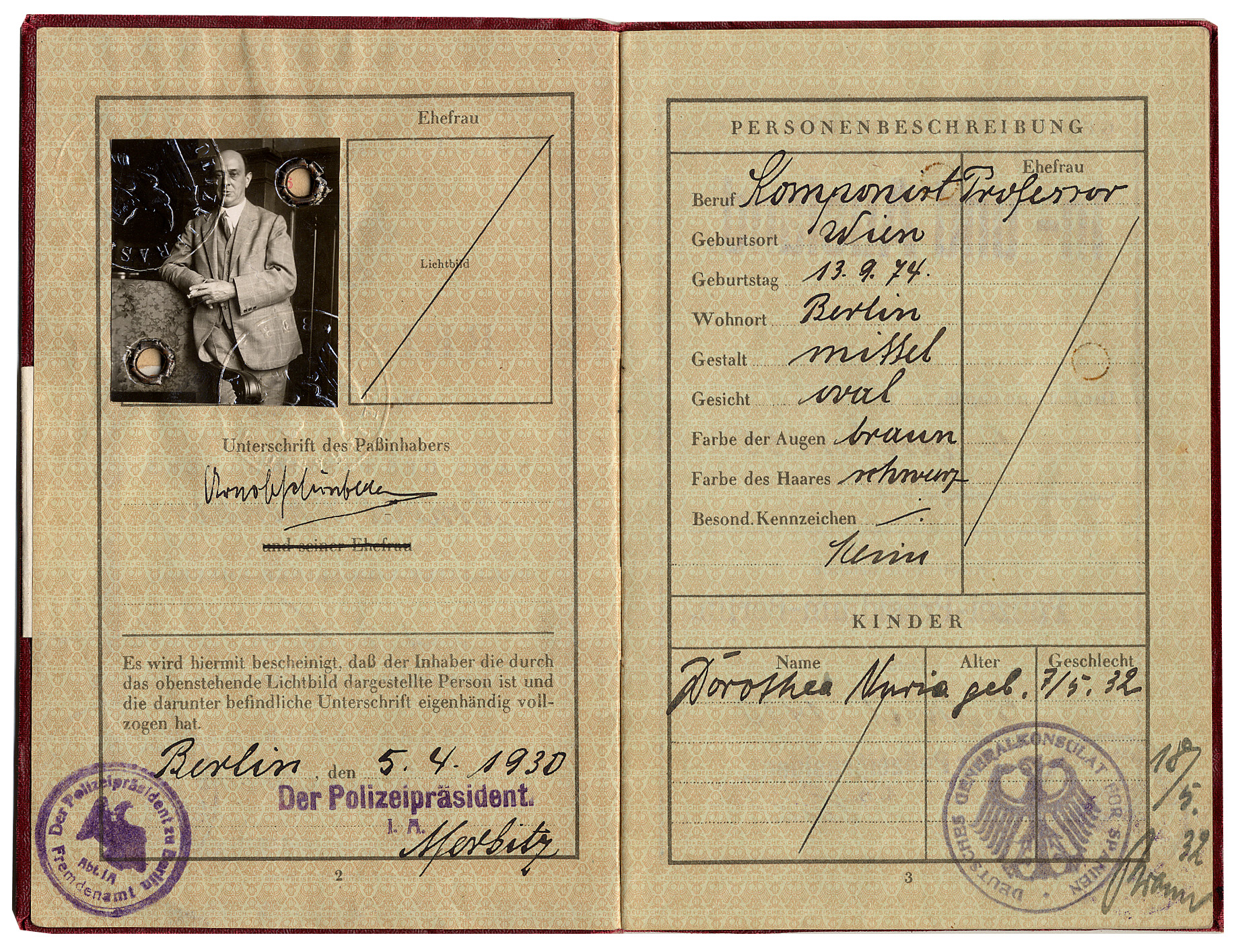
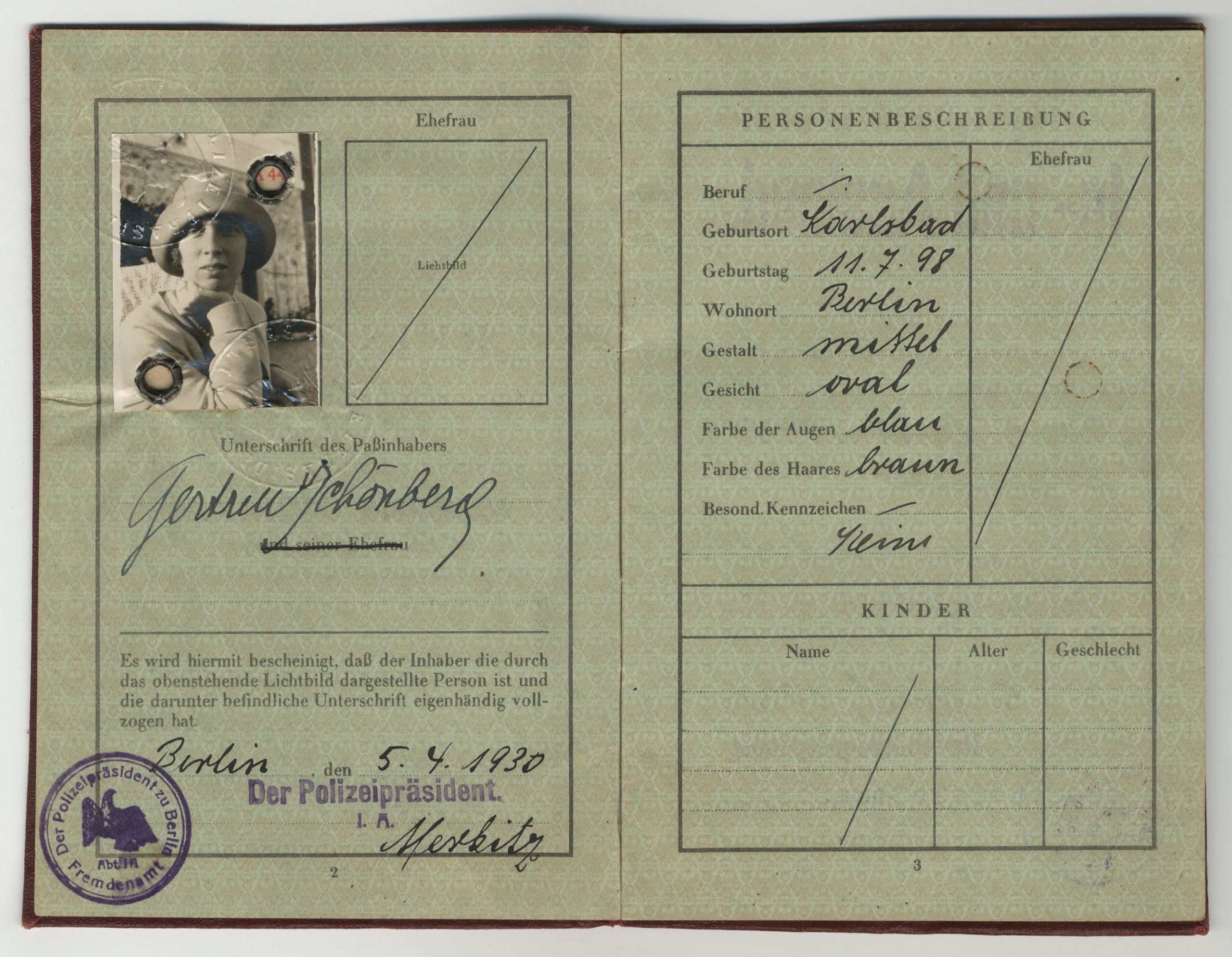
In 1925, my grandfather was appointed to an important teaching position at the Prussian Academy of Arts in Berlin. Upon accepting that position and taking an oath, he automatically became a German citizen. And by law, so did my grandmother. This explains why they held German passports, with which they travelled until 1933.

February 3, 1927 letter from the Prussian Ministry of Science, Art and Education confirming that Arnold Schoenberg obtained Prussian (German) citizenship when he was appointed to a professorship at the Prussian Academy of Arts.
Arnold Schoenberg’s German passport issued April 5, 1930
Gertrud Schoenberg’s German passport issued April 5, 1930

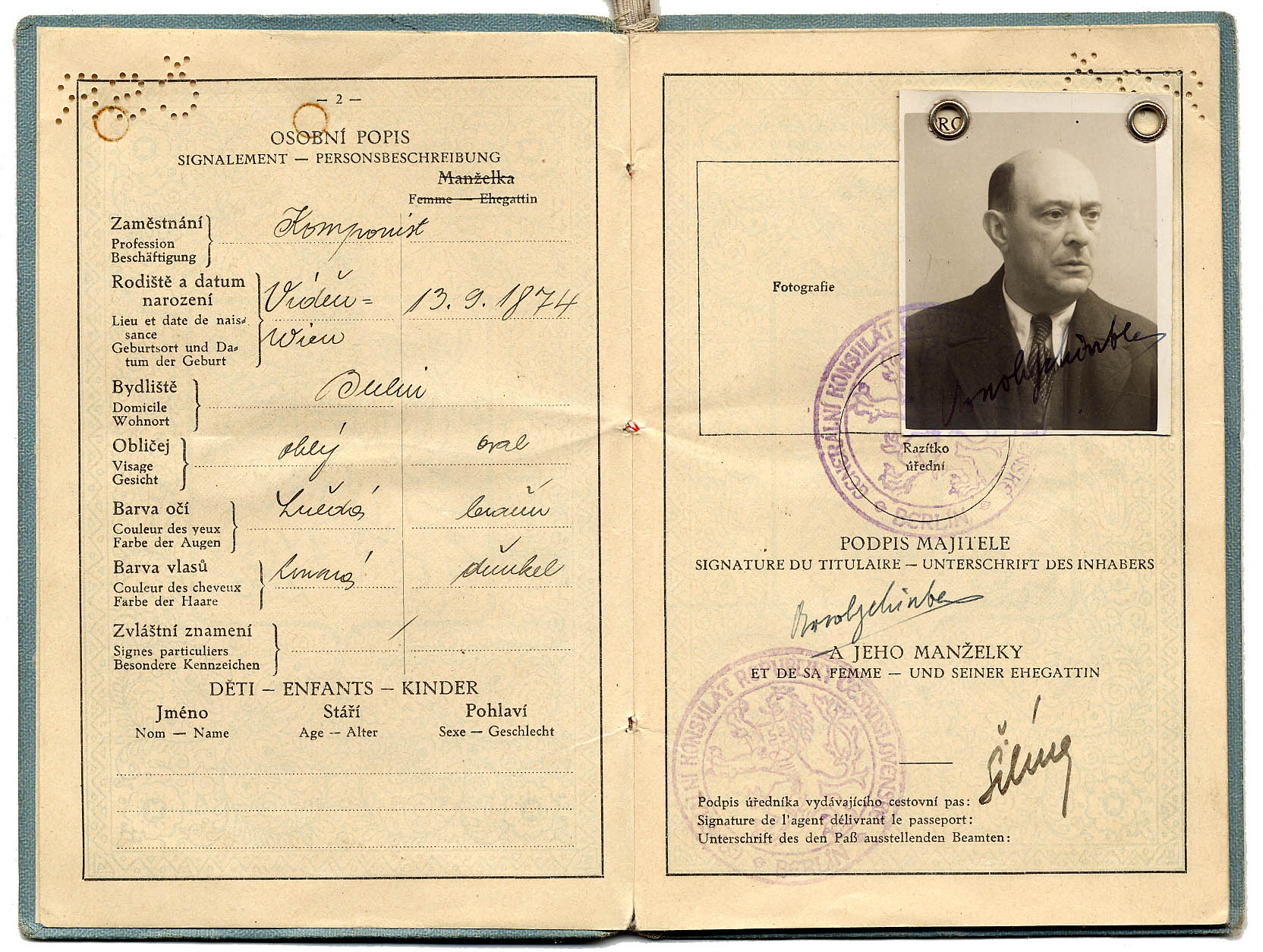
In January 1933, the Nazis rose to power in Germany. Almost immediately, they moved to expel Jewish professors from their positions. Seeing the writing on the wall, my grandparents prepared to leave. They went to a friendly Czechoslovakian consul, Camill Hoffmann (later a victim of the Nazis), who on April 29, 1933 secured for them temporary Czechoslovakian passports, initially valid only for just three months. It was with these passports that they fled at midnight on May 17, 1933 from Berlin to Paris, and then on to the United States in late October 1933. They apparently left some of their original citizenship documents with the Czechoslovakian consul in Berlin, who sent them on to Prague and Bratislava, but the documents were never returned and have not been located.

Gertrud Schoenberg’s temporary Czech passport issued April 29, 1933

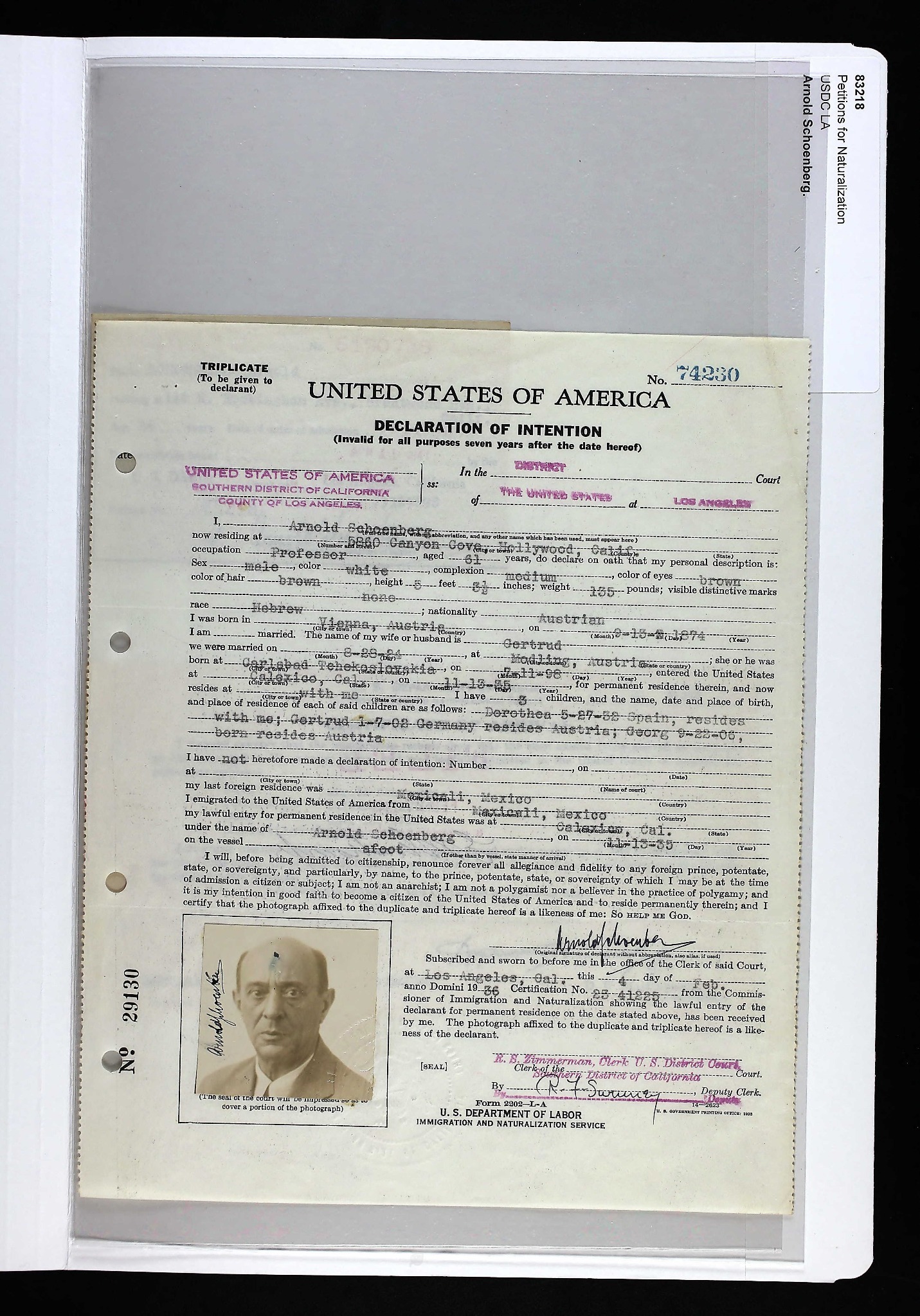
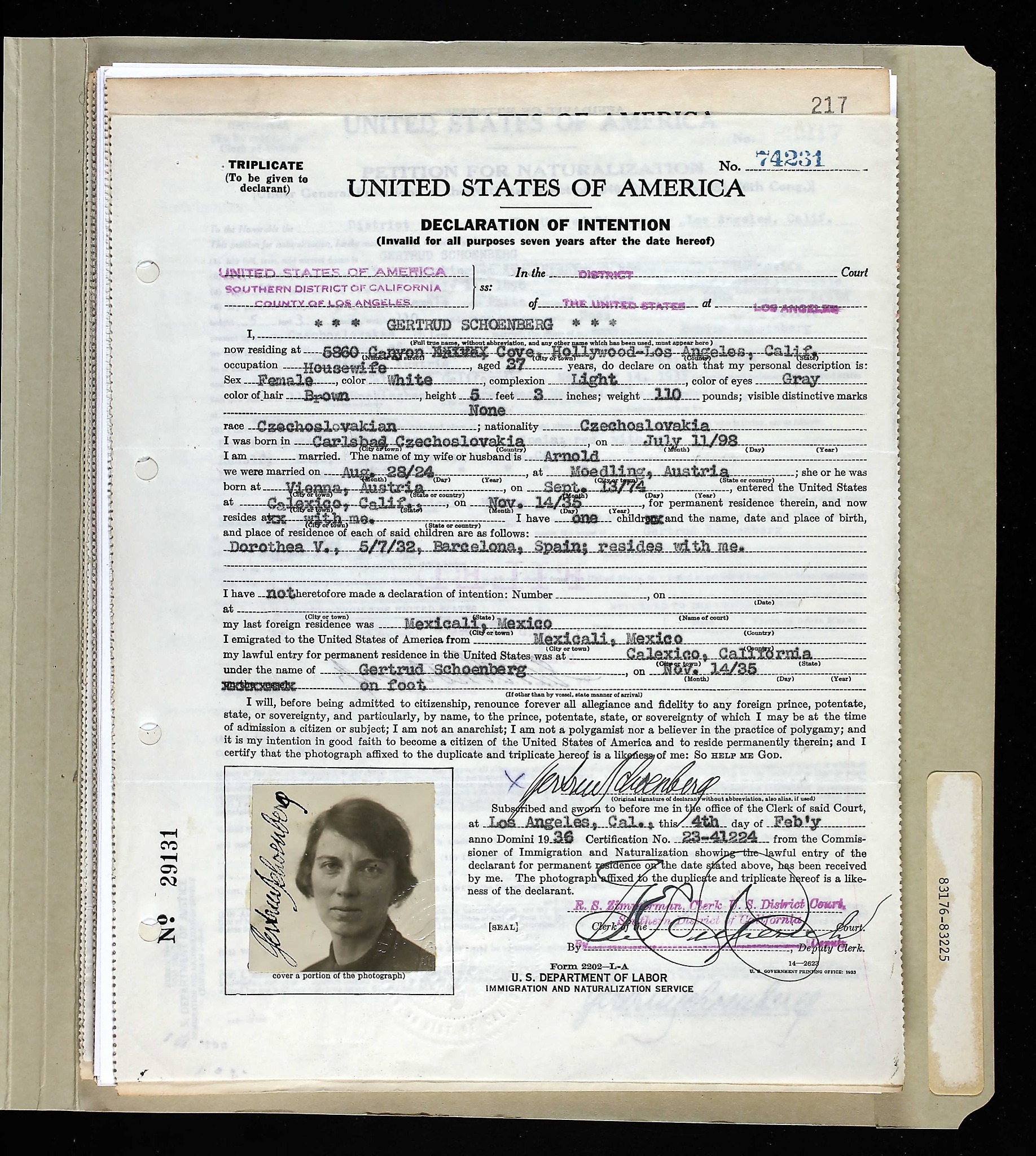
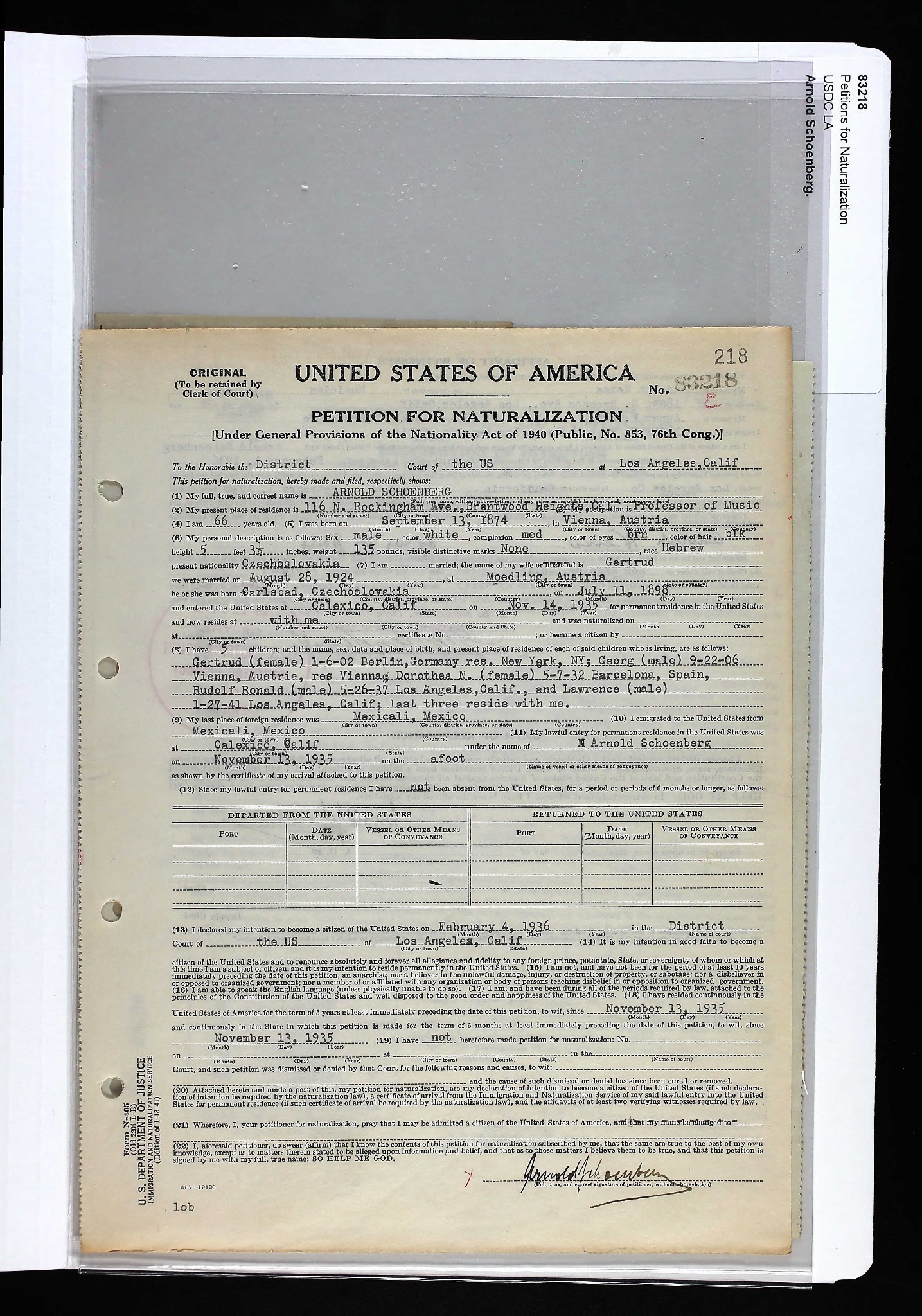
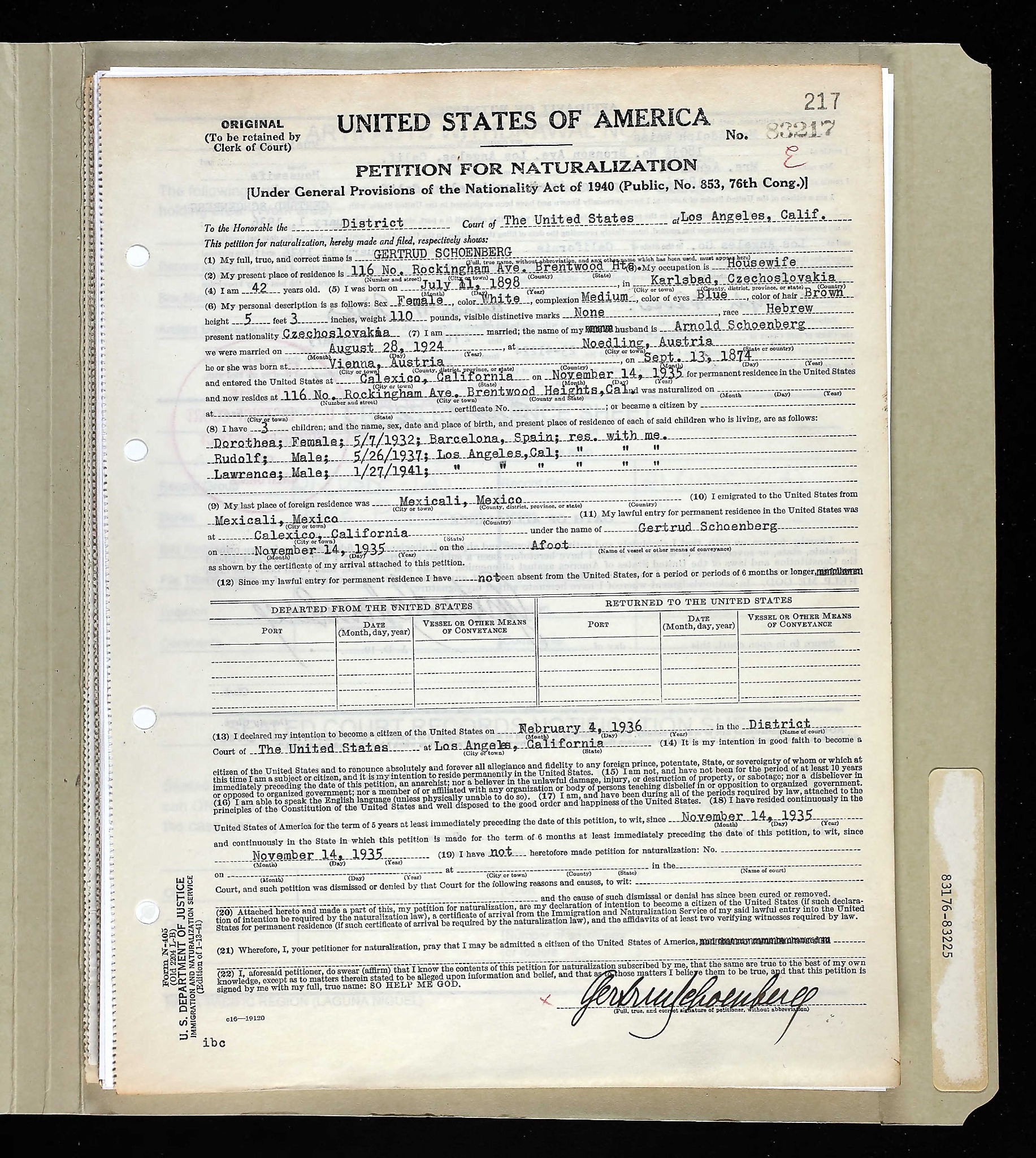
Two years after arriving in the United States, and a year after moving to Los Angeles, my grandparents decided to apply for U.S. citizenship. In November 1935 they travelled down to Mexicali on the California border to leave and re-enter the country in preparation for their application for citizenship. Arnold’s Declaration of Intention signed February 4, 1936 says his nationality was “Austrian.” But Gertrud’s says Czechoslovakia and both Petitions for Naturalization filed that same date list their present nationality is “Czechoslovakia.” (I especially like that they say they crossed the border “afoot.”)

Arnold Schoenberg’s Declaration of Intention February 4, 1936
Gertrud Schoenberg’s Declaration of Intention dated February 4, 1936
Arnold Schoenberg’s Petition for Naturalization February 4, 1936
Gertrud Schoenberg’s Petition for Naturalization dated February 4, 1936

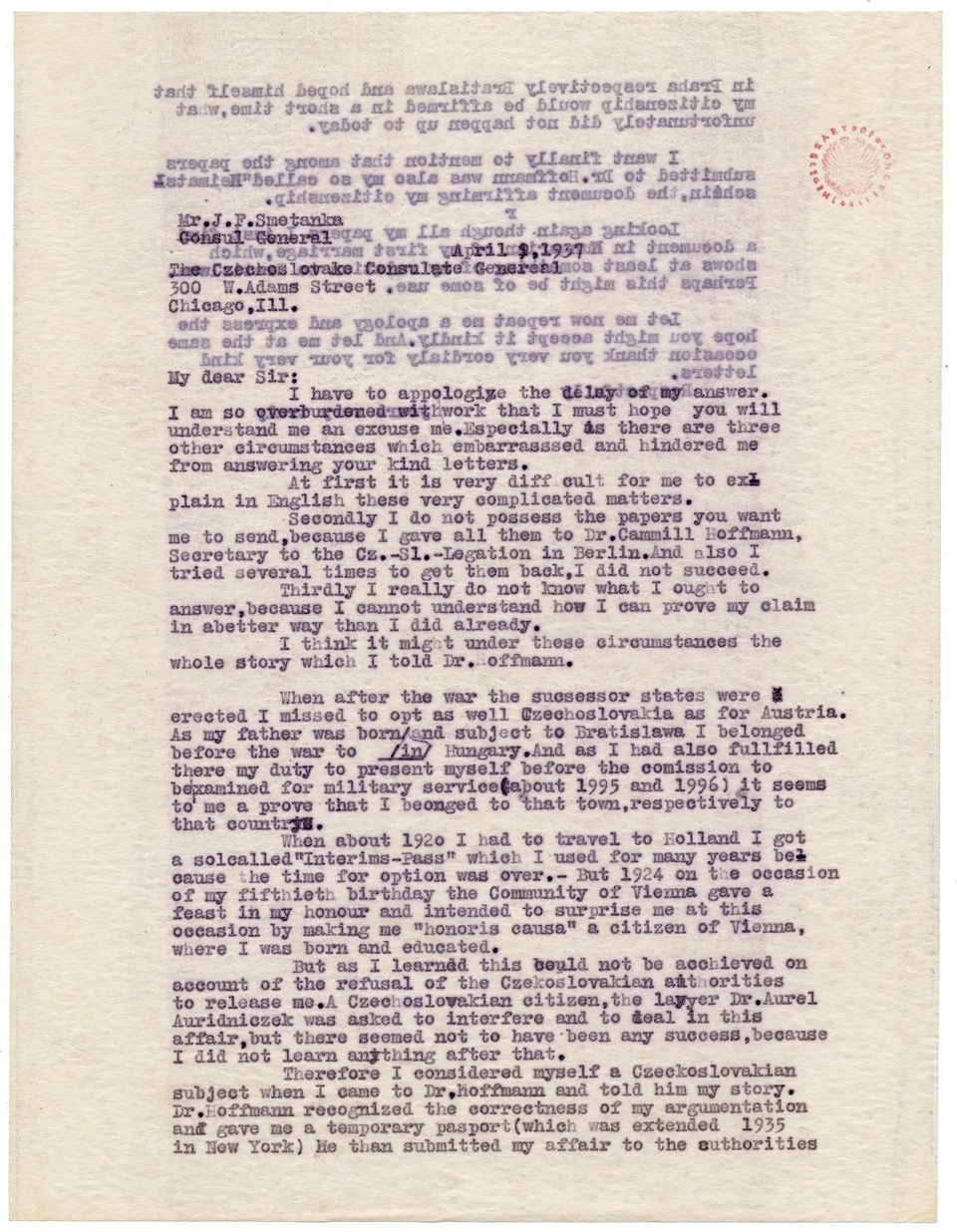
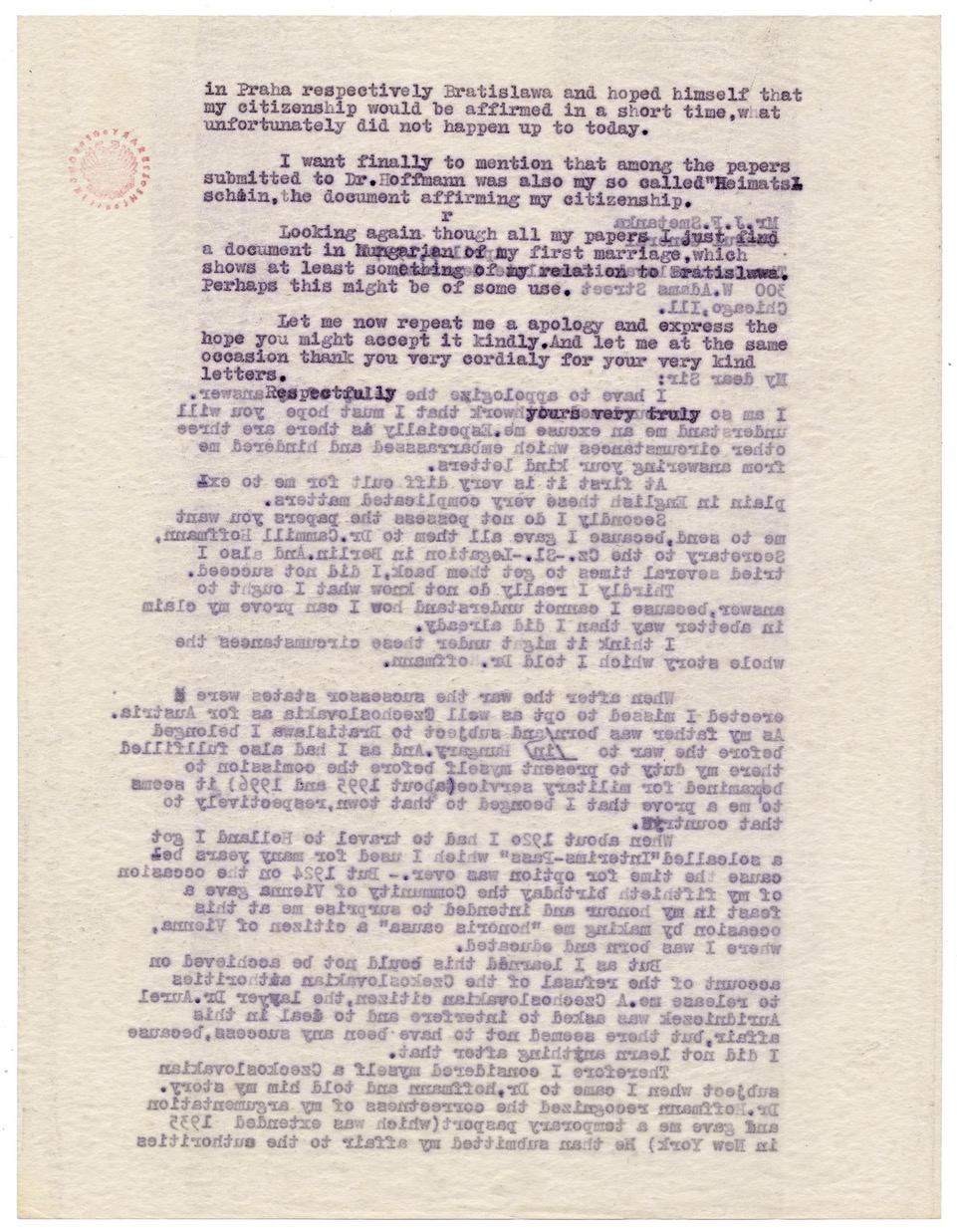
Even after applying for U.S. citizenship, my grandfather attempted to clarify his Czechoslovakian citizenship. The Czechoslovakian consulates in New York and Chicago stubbornly requested further information, including “how much time you spent in Czechoslovakia since the end of 1918 and where you were living.” My grandfather tried to explain his situation, but was unsuccessful in convincing the Czechoslovakians to confirm his citizenship. In March 1939, Czechoslovakia was invaded by Nazi Germany and so from then on the issue was moot.

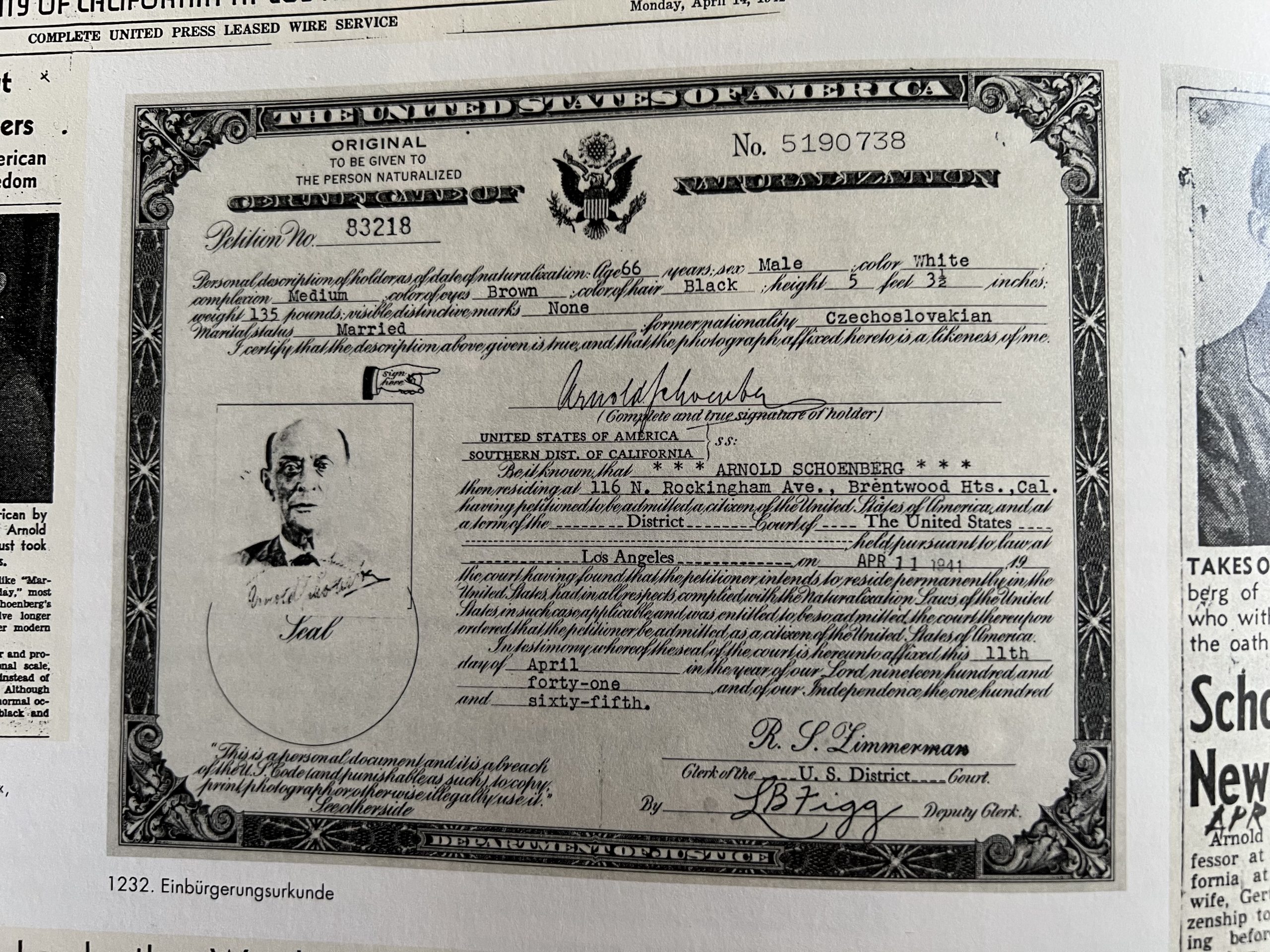
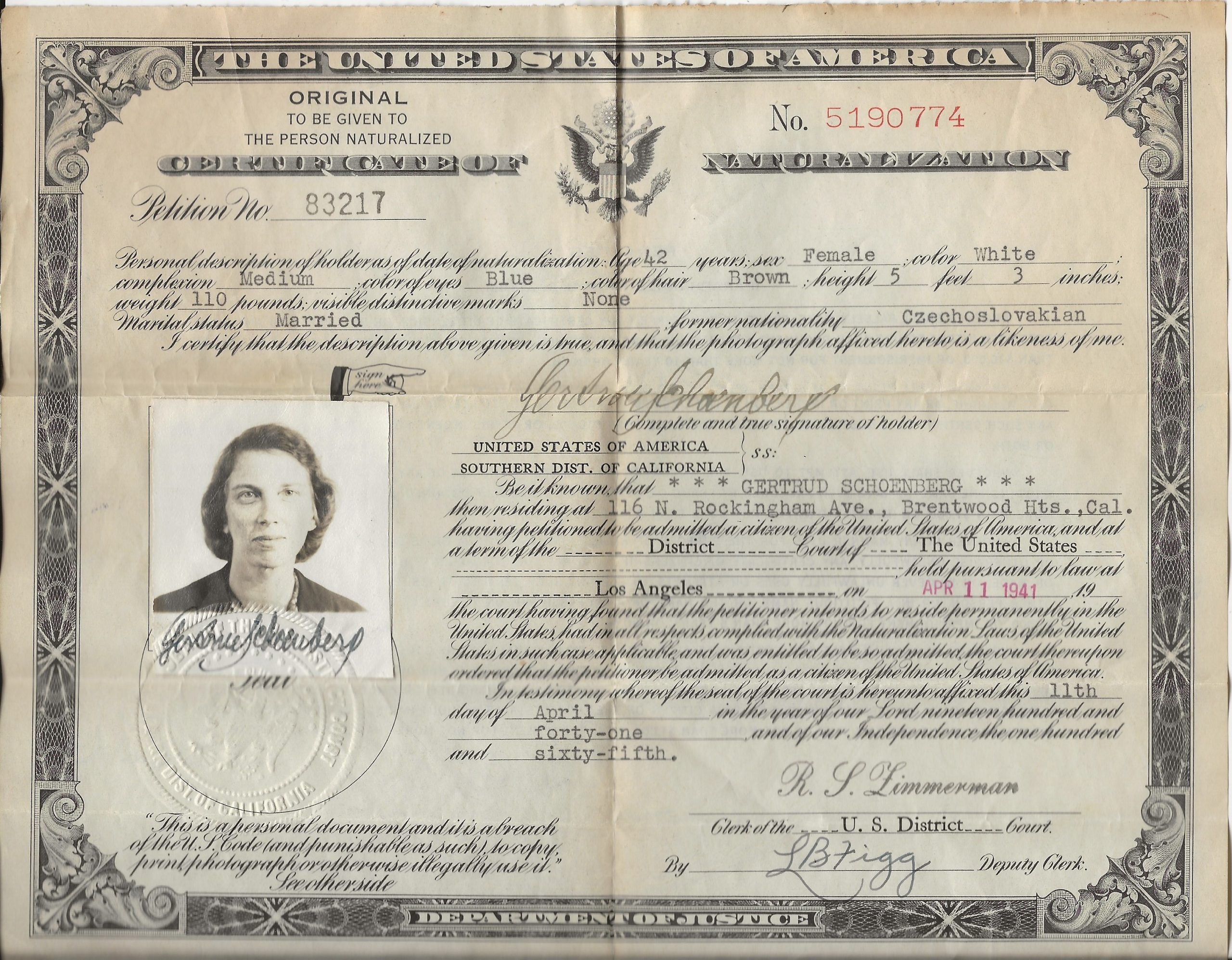
On April 11, 1941 my grandparents became U.S. citizens. They were fortunate to have applied in 1936 as Czechoslovakians, since at that time there was not yet a large number of immigrants from Czechoslovakia, and so they easily fit into the national quotas that the United States had imposed in the very racist Immigration Act of 1924.

Arnold Schoenberg certificate of naturalization April 11, 1941
Gertrud Schoenberg certificate of naturalization April 11, 1941

With that background I set out to apply for Czech citizenship under the new provision allowing the descendants of Czech citizens to obtain citizenship. I decided that my grandmother Gertrud Schoenberg would be the best ancestor to use for my application because she was actually born in Karlsbad, or Karlovy Vary in today’s Czech Republic. I figured that a grandparent born in the country who came to the United States with a Czechoslovakian passport would be a sure thing. Boy was I wrong.

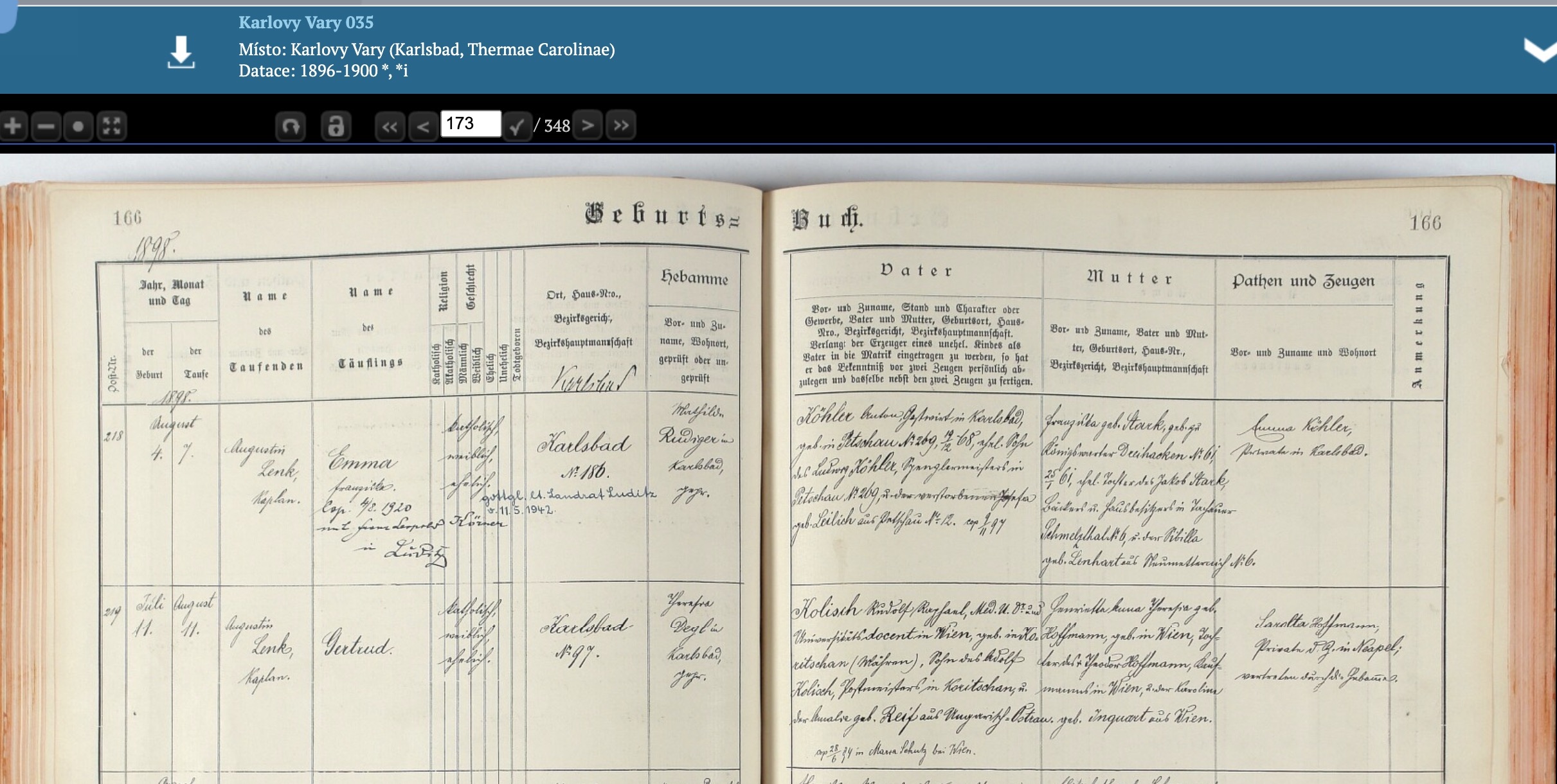
The first thing I needed to do was get my grandmother’s birth certificate. Since her father had converted from Judaism and her mother had a non-Jewish mother, my grandmother was not born Jewish and her birth is recorded in a Catholic record book. Even though you can now view her record for her birth on July 11, 1898 online, I was required to submit a notarized application requesting a certified copy of her birth certificate. The Karlsbad birth record very clearly lists her parents and their parents. Her father was Dr. Rudolf Kolisch born in Koritschan, or Korycany in today’s Czech Republic. Anyone who understands how things worked in the old Austro-Hungarian monarchy would immediately understand from this that my grandmother, although born in Karlsbad in Bohemia, was almost certainly registered for citizenship purposes as having home right (Heimatrecht) in Koritschan, Moravia. Of course, not everyone in today’s Czech Republic understands how things worked back then. Many aren’t even old enough to remember the fall of Communism in 1989. And so, unbeknownst to me, the Czech authorities spent the first year after my application searching fruitlessly for confirmation of my grandmother’s citizenship in Karlsbad. Frustrated, I turned to the Facebook group “Applying for Czech Citizenship.” They were very supportive and sympathetic, and helped me understand what the authorities were requesting.

Birth record of Gertrud Kolisch July 11, 1898 Karlsbad

Before I describe the numerous indignities suffered during my Czech application, I have to explain one additional issue I needed to resolve. Unlike many other countries, Austria does not ordinarily permit dual citizenship. Or more accurately, they have a rule that if you are an Austrian citizen and you obtain another citizenship, you automatically lose your Austrian citizenship. Not wanting this to happen when I applied for German and Czech citizenship, I made a special application for “Beibehaltung,” literally permission to keep my Austrian citizenship in the event I received another citizenship. I was told by various experts, including an Austrian lawyer I paid to help me prepare a petition, that this was impossible and that I would not succeed. In the end, with the help of a friend’s father who translated my accompanying letter into perfect German, and some pressure from some other friends, including an Austrian ambassador, I received my permission. I am not sure which factor was the clincher, but I did argue that my collecting of citizenships was an act of restitution as a result of Nazi persecution. Notwithstanding my well-known efforts to remove Klimt paintings from Austria, I also travel there frequently as a board member of the Arnold Schönberg Center. So I did have at least some justification for maintaining my citizenship. In any case, after applying in January 2021, I received permission in April 2021 to obtain German and Czech citizenship within two years. The German citizenship was a bit easier, although not without some pushback — the German authorities wanted to confirm when my grandparents lost their German citizenship, apparently stumped by the fact that my grandparents fled before their citizenship could be officially stripped away — and success came relatively quickly in October 2021. The Czech application was more difficult as it required lots of expensive certified translations into Czech, but I filed it with the local Czech consulate (which is very close to where I live) in August 2021.

In January 2022, the Czechs asked me for “proof of loss of Czech citizenship of your grandmother” and her death certificate (certified with apostille and then translated into Czech, of course). They said I needed to apply for the proof of loss of citizenship and sent me a form, which I filled out and filed in their office after obtaining all the requested documentation. In July I finally received a response, a request for further information about my grandmother’s citizenships, whether she was ever an Austrian citizen and her German citizenship. More complications.

My grandmother’s citizenship history turned out to be as complicated as my grandfather’s. Although it was clear that her father Dr. Rudolf Kolisch (1867-1922) was from Koritschan, Moravia (a town currently in the Czech Republic) where his father Adolf was the postmaster, the records for that town prior to 1918 are scarce. I made numerous requests to the municipal and regional archives in that area (including not only Korycany, but also Kyjov and Hodonin) but they found nothing. There is an 1857 census with the family, but not Rudolf who was born in 1867. Another census in 1869 lists Rudolf (with the birth year 1868, but he was born 1867).

After his father Adolf died in 1878, Rudolf moved to Vienna as a boy to go to school and may have lived with an older sibling. In 1880 Rudolf is listed in Vienna as a student at the Franz Joseph Gymnasium. He went on to study medicine, also in Heidelberg, Germany and then returned to Vienna where he treated patients with diabetes. He wrote several important articles and a book on diabetes before dying in April 1922, shortly before the announcement of the discovery of insulin. Rudolf married my great-grandmother Henriette Hoffmann in 1894 in the small resort town of Maria Schutz am Semmering in the hills outside Vienna. During the summer months, Rudolf moved the family to Karlsbad in Bohemia, where he treated wealthy patients and earned money to pay for his research in Vienna. My grandmother Gertrud was born there in July 1898.

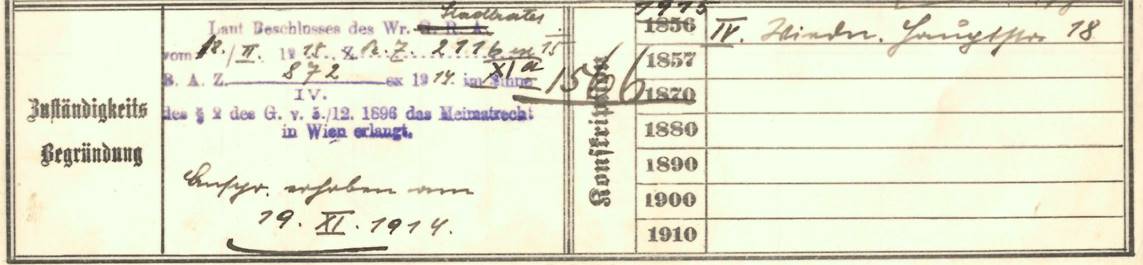
I asked the Vienna municipal citizenship office (MA35) to search for information about the Kolisch family to determine whether they had become Austrian citizens. The answer came back that according to their records, my grandmother, her parents and siblings all became Austrian citizens on February 18, 1915. This is almost certainly incorrect, but I have yet to figure out what explains it.

Kolisch family residing at Wiedner Hauptstrasse 18 obtains citizenship in Vienna with date February 18, 1915

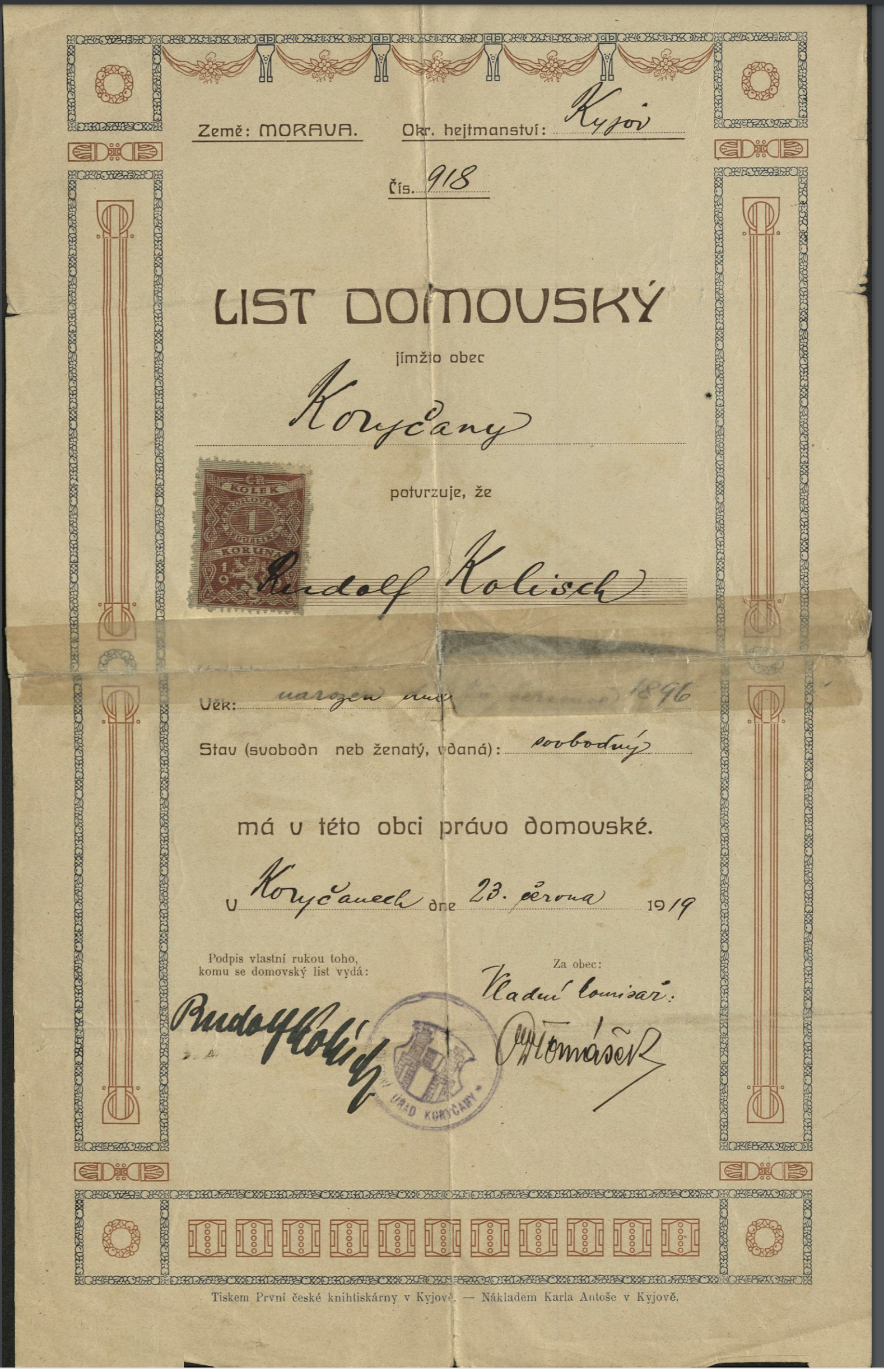
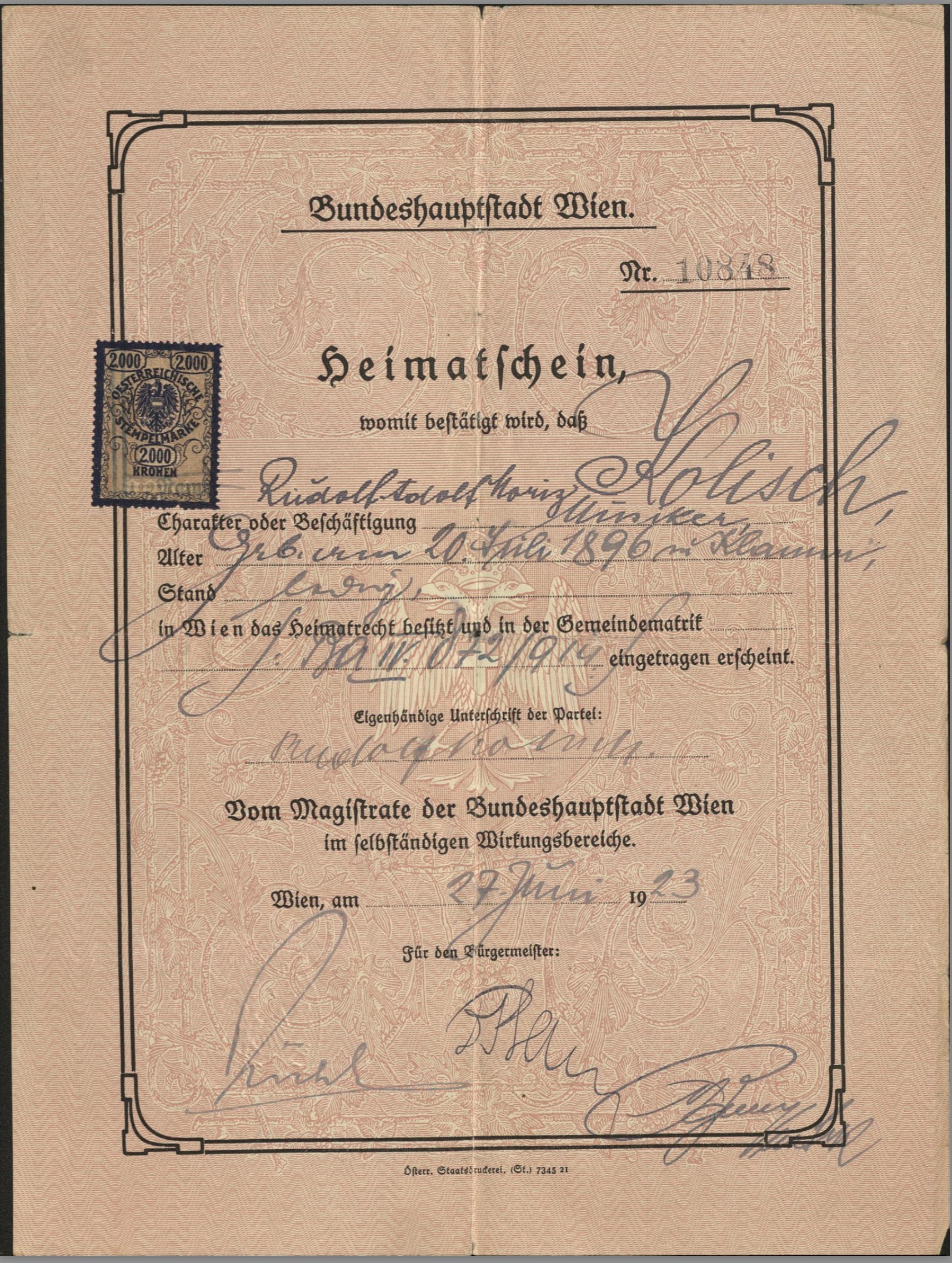
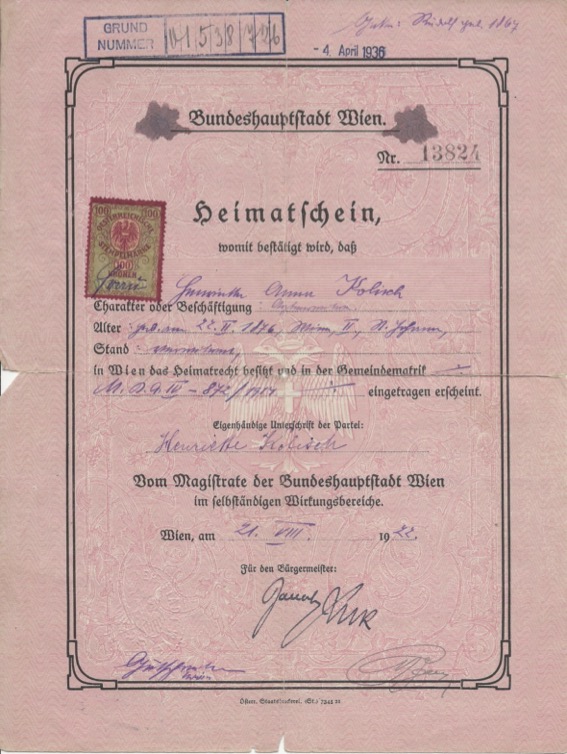
The contrary evidence is overwhelming. When my great-grandfather Rudolf died on April 7, 1922, his death record lists his citizenship (Zuständigkeit) as Czechslovakian (although with a question mark). Shortly before that he had written a letter to his department complaining of their failure to make him a full professor, allegedly because he was a foreigner. When my grandmother’s older sister Mitzi married in 1920, her documents say she was a citizen of Koritschan. I contacted the Harvard University archives of my grandmother’s brother the violinist Rudi Kolisch and they found his Czechoslovakian citizenship papers issued in 1919. His Austrian citizenship document is dated June 27, 1923. My great-grandmother Henriette Kolisch’s Austrian citizenship document is dated August 21, 1922. My guess is that after Dr. Rudolf’s death in 1922, the Austrian citizenship was recorded for the entire family, perhaps retroactively to 1915.

1919 Czchoslovakian citizenship papers of Rudolf Kolisch born 1896.
1923 Austrian citizenship papers of Rudolf Kolisch born 1896.
Austrian citizenship document (Heimatschein) of Henriette Kolisch dated August 21, 1922.

In any case — whether my grandmother became an Austrian in 1915 or 1922 or never — when she married my grandfather in 1924 she automatically obtained his citizenship, which should have been Czechoslovakian, since he was not Austrian. Upon his appointment to the position in Berlin in 1926, she would have followed him and become automatically a Prussian German citizen. As demonstrated above, she obtained a temporary Czechoslovakian passport in April 1933 and fled with that to France and then to the United States, where she applied for U.S. citizenship in February 1936 and became a U.S citizen in April 1941.

The 2019 Czech citizenship law allowed me to obtain Czech citizenship if my parent or grandparent was a former Czechoslovak citizen. If I had a Czechoslovak citizenship document for my grandmother, as I did for her older brother Rudi, I think the task would have been easier. But without that document, the Czech authorities wanted to find something else to rely on, and that could not be found.

I tried to obtain documents in Bratislava from the Slovak government since my grandfather and grandmother should have been registered there. The Slovak consulate in Washington DC was terrifically responsive, very friendly, helped me apply for a document confirming my grandmother’s Czechoslovakian citizenship. But despite the friendliness of the consular office, the folks back in Bratislava were less obliging. The problem, I believe, is that for Czechoslovakia the 1921 and 1930 population censuses are their key sources. But my grandparents were not included in those censuses because in 1921 they were in Vienna and in 1930 they were in Berlin.

I obtained a statement from the authorities in Vienna confirming that my grandmother lost her Austrian citizenship when she married my grandfather Arnold Schoenberg, a Czechoslovakian citizen, in 1924. I also obtained a statement from the German consulate confirming that my grandmother obtained German citizenship in 1926 with my grandfather, who also would have lost his citizenship when he became a U.S. Citizen in April 1941. As a result, my father, born in Los Angeles in 1937 would have been born both a German and US citizen, but would have lost his German citizenship as a result of the decree expatriating all German citizens with Jewish background on November 25, 1941.

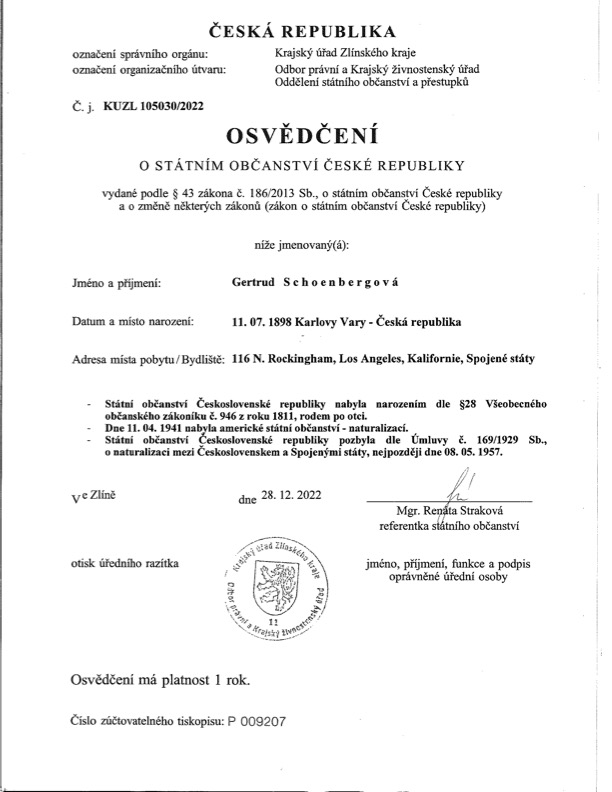
But the real solution to the problem was retaining the assistance of a young Czech lawer, Jonatan Müller, the son of my good genealogy friend Julius Müller. Jonatan viewed the file on my application in Prague and spoke with the authorities involved. They were unmovable in their insistence that we provide some official Czech document showing that my grandmother had lost her Czechoslovakian citizenship. Jonathan decided that the key bureau would be in Zlín in Moravia. That office was authorized to create citizenship documents where the originals were missing in Koritschan. Jonatan went to Zlín to explain the situation, presented all the evidence we had assembled, and ultimately prevailed on the authorities to issue the necessary document, a statement declaring that my grandmother had lost her Czechoslovakian citizenship because she became an American citizen on April 11, 1941.

That document did the trick. It says that my grandmother acquired her citizenship under an Austro-Hungarian law of 1811 through birth. She lost her Czech citizenship no later than May 8, 1957, as a result of her US naturalization on April 11, 1941. (In 1941, Czechoslovakia was in a state of war, having been occupied by Germany, and so she could not have lost her citizenship at that point, but only later pursuant to a treaty with the United States.) The office in Prague relied on the new document and issued me my Czech citizenship. Whether or not the date of her loss of citizenship is correct, and it may not be, there is no doubt in my mind that my grandmother was born with home right in Koritschan, Moravia and that she most likely was a Czechoslovakian citizen after World War I. At some point, probably 1922 or 1923, she probably became Austrian, and then became Czechoslovakian again when she married my grandfather in 1924. She may have lost her Czechoslovakian citizenship in 1926 when she became a German citizen, and she may also have been entitled to be a Czechoslovakian citizen again when my grandparents obtained the temporary Czechoslovakian passport in April 1933. In that case, she would have lost the Czechoslovakian citizenship again (for a third time?) at some time after 1941 when she became a U.S. citizen.

The officials who handle these citizenship requests would like things to be simple, but when dealing with citizenship in the Austro-Hungarian Empire through the Nazi era, things are often not so simple. I am fortunate to have the time and resources to make a successful application for citizenship. I fear others might not be so lucky. Nevertheless, I feel good knowing that I have shown how it is possible to obtain Czech citizenship, even when some of the key documents are missing.

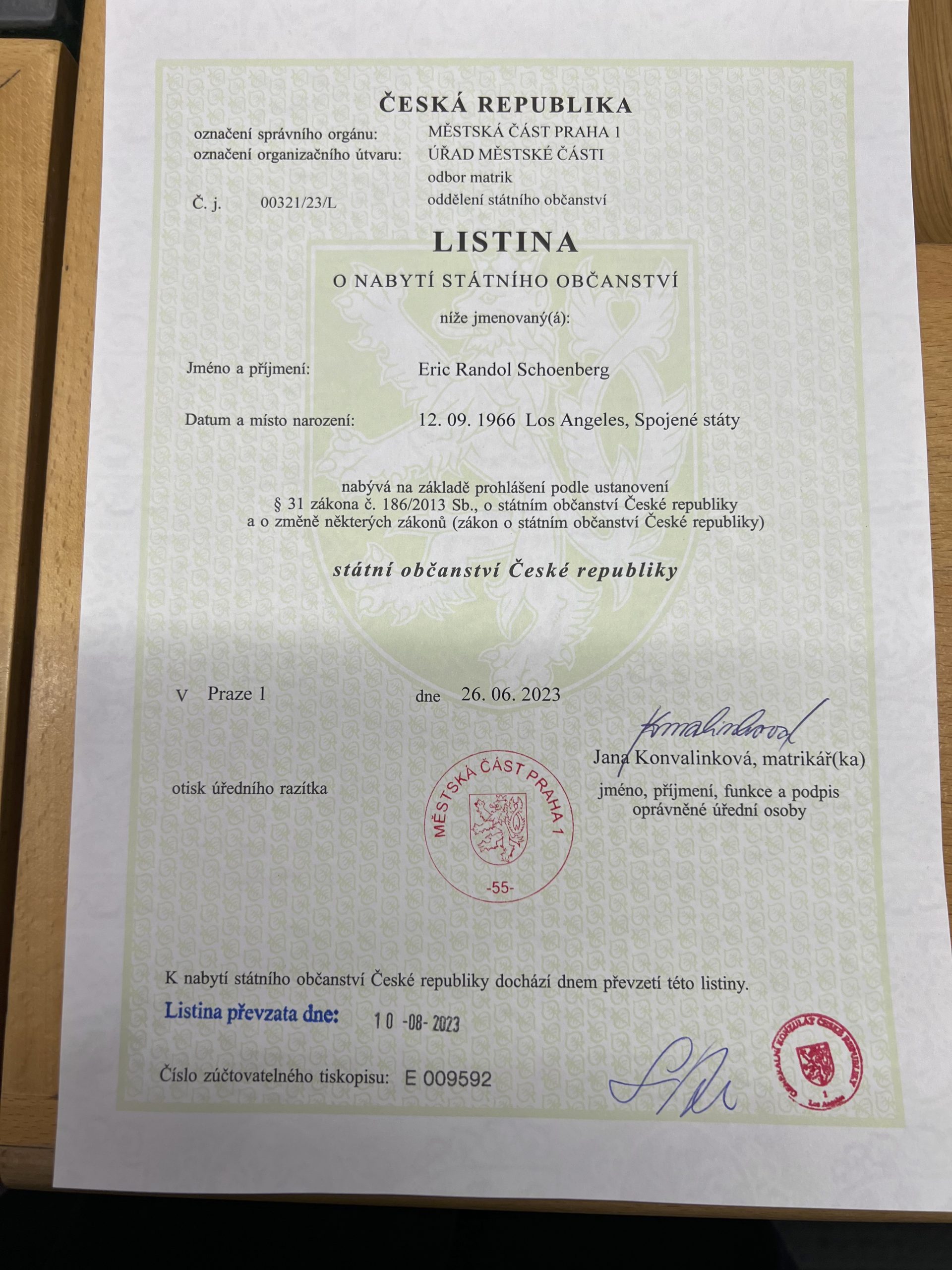
My Czech Citizenship Certificate issues August 10, 2023.

They Should Know Who Olga Neuwirth Is

The pandemic overshadowed and distracted us from a truly historic achievement. Well, Olga Neuwirth is an accomplished composer who has written many works including the operas: Lost Highway, American Lulu, and Orlando. I interviewed her on October 30th, 2020 at the Arnold Schönberg Center in Vienna. She “…grew up in a ’68 hippie family with only artists” and was born in 1968 in Graz, Austria. She called herself “a punk from the countryside.” The “punk” grew up playing mainly trumpet, before she had a car accident on the day she got her braces removed, causing a broken jaw and thus the end of her trumpet career. Olga also learned piano, but had a “… problem in [her] brain coordinating [her] left and right hand”. When she wanted to play a black key, she would play a white key. Thankfully, she was the drummer in her punk band, which helped correct the issue. In her punk band, she also played a little electric guitar.

I asked Olga who her biggest inspirations were growing up. She responded with the Beastie Boys, Patti Smith, Luigi Nono, and Miles Davis. The first two artists show her youth, punk, and rebellious side. Olga met Nono four times. The first time was in Vienna when he was the composer in residence at the Wiener Konzerthaus. She was a student and as a fan curious for knowledge walked up to him to ask him questions. The second time was while Olga was a student in Aix-en-Provence studying in a music program, which, she said, was Nono’s last workshop. Her main professor was Nono. The last two times were in Venice. The Miles Davis inspiration came from her father being a jazz musician and her passion for trumpet: “I wanted to be a female Miles Davis.”

Through her inspirations and circumstances, Olga found herself on the composer track almost accidentally. She originally wanted to be a trumpet player and in her punk band “…played drums like Eddie Funk, but more like Eddie Punk.” After her car accident, she was out of school for a while. When she returned, Hans Werner Henze, a German composer, came to her village looking for young musicians for his project he had at the time, to show the creativity in everyone. Olga did not want to join the project, but as a gifted musician who just lost her favorite instrument, her teacher made her join. This project started Olga’s path to become a composer. After the project, at age 16, she went to school in San Francisco for a year. At the time, she was not sure whether she wanted to go into film, composition, or painting. At San Francisco Conservatory of Music, she studied composition, but at the Art School of San Francisco Bay she studied film and painting. After life in San Francisco became too expensive, she returned to Austria having chosen composition.

Building on her musical inspirations, I asked Olga what inspired the opera Orlando musically, besides the book written by Virginia Wolf. She reiterated her diverse musical background. She studied and was around music and musicians of classical, jazz, and punk backgrounds. This instilled a way of thinking in her mind; “[I] was never about borders of what is the “right” music.” Her musical identity is made up of parts that together make a whole. In Orlando, the character is a male writer who becomes a woman overnight, but dresses like a man as well. “Orlando goes through these centuries: for [Orlando] it’s about the history of writing more, for me, also the history of music.” She remembered her talks with Nono and what she had learned from his music: “how to combine past and present.” Like Nono she wanted to never be in a box that is “why he went to other countries to hear other music… and see traditions from other cultures. He was always curious and open. There’s not one canon of what is the right music.”

Just like bringing genres together, Olga has brought people together with her choice of works. Today’s culture is becoming very inclusive, particularly with gender and sexual identities. This is a huge topic in Orlando and thus for Olga “the second interest” in her life; “if there are no boundaries in music, there are no boundaries [on] how you would like to live, who you consider yourself, who you are.” While living in San Francisco, Olga had many friends who did not identify as straight and many who had AIDS. She participated in many protests in the area, including one over the murder of Harvey Milk, the first openly gay elected official in Californian history. From a young age, she was always a proponent for diversity in life and gender decisions. Olga wanted to show the plight of a transgender person in Orlando, but also the struggle for a woman to be equal to a man in life, as a writer, and as an artist. Women have been degraded and dissuaded from pursuing their passions. The patriarchal society that we live in supports a man’s climb to the top, but not a woman’s fight. Orlando was written and chosen in small part due to its humor, but mainly to show a parallel from Olga’s hardships making it as a female composer/writer to Orlando’s story of adversity.

Even though Olga Neuwirth’s Orlando became the first opera created by a woman to be performed in the 150+ year history of the Wiener Staatsoper, she has still faced the troubles of the music industry. I asked her what she would continue to do for future women in future generations to help them overcome the patriarchal oppression she has endured: “There’s still a lot of things to do” she said, “but maybe it’s not for my generation anymore. The next generation has to fight. I was really going into desert land.” Olga has done so much for future women just by continuing her work. She has become a role model for young women who want to go into the arts. But her lack of knowledge on what to do next troubled me. It seemed as if the industry had worn her out, but mainly, there are still a blinding number of obstacles left to move out of the way, as evidenced by Olga’s publishers and the Wiener Staatsoper, who told her to rewrite Orlando due to the experimental music and subject matter. She, of course, refused. Usually an opera created by a composer of her stature would be asked to return for more performances before it is ever played. Olga was told “…we have to see if it is a success.”

Orlando went on to be a success. It was performed in December 2019 for five sold out nights. Afterwards, she was then again asked to rewrite the opera. She said, “if you write it the right way we might perform you,” mocking the patriarchal society, those who told her to rewrite the opera, and what they had told her. Even with these battles she still has been able to push boundaries and bring people together.

Olga is very passionate about mixing genres, which she believes is the way for music to evolve. Opera is becoming much less popular for today’s youth. Younger people, in general, do not go to the opera. But Orlando got many people of the younger generations to go see the opera. It drew a non-traditional audience. The older and more classical-music-minded people did not like the second half very much, but that was the favorite of the “new-comers.” “This could be the future of opera,” Olga said about mixing genres. I pointed out how Arnold Schönberg held his Skandalkonzert, which debuted his atonal music in 1913. The concert resulted in tomatoes being thrown and subsequently a riot breaking out. “Whenever you start something you have obstacles. Just as Schönberg and Nono… you immediately run against the wall of 100+ years of petrified minds who think this is the right way to do something.” Olga kept hammering this sentiment to me: “You can’t go back!” This is something Olga Neuwirth has done her whole life and is a part of her identity: “it’s me. This is my life.” I asked her to elaborate on how she gained this attitude and stuck with it early in her career when most artists are pushed into becoming more mainstream. “I wasn’t taken seriously; I had to fight to be taken seriously,” she said. “I was considered the young fool, but I was freer to do things… I didn’t have a teacher and wasn’t in a school.” That second part surprised me, so I asked her to further explain: “I could try out more things than I can try out now, because I have this name or whatever. You get these stupid labels. I’m not interested in these labels.” Most artists when they start are pressured by the industry to be something they are not, so that the music is more easily listenable and commercially successful. “They try to put you in this drawer.” Olga’s journey is more unique, but not entirely bizarre. She had freedom to show her own style, but now that she has made it, she is asked to conform to the publishers and others (who are a part of the industry) who want her to continue to be successful for their own monetary gain. “Sometimes the fool is allowed to say even the worst things to the king. No one is allowed to say these things to the king or person in power, except for the fool.” Olga used such a great metaphor. The up-and-coming musician is very much like a jester to the rest of the industry. One that tries something different must be mistaken. However, the strongest part of the metaphor is that the industry thinks they can trick or manipulate the fool.

This brought up a similar situation with Dave Chappelle. Dave Chappelle turned down $50 million from Comedy Central because he thought that was below his value, but mainly because of the creative freedom he wanted. I mentioned to Olga how he “fled” to South Africa as a result, to which she responded “yah, clever.” “They try to put you in their drawer, which was never your life or why you started something” she continued. Dave Chappelle recently won this battle against the industry. His new video entitled Redemption Song depicted why he left Comedy Central and how after asking the public not to watch Chappelle’s Show, Comedy Central paid him millions of dollars and gave him the rights to his name and likeness back. “You have to have a lot of strength to fight against it, otherwise you are just captured and not who you are anymore.” Thankfully, Olga and Dave are strong.

Another lively topic in today’s world was, and is, artists owning their masters. Kanye West has been a huge activist in this field and Taylor Swift recently rerecorded an album (planning more) because her masters were sold without her being given a chance to match or beat the offer.[1] Artists in the United States earn 12% of the overall revenue made by the music industry.[2] That is the lowest percentage of any profession comparatively. I asked Olga if she owned her masters. She responded with the story of trying the get everyone’s contracts and shares correct for Orlando. The publishers, DVD companies and Wiener Staatsoper demanded most of the rights, but the musicians, stage hands, advertisement firms, etc. all demanded a piece. It took her months to get everything settled because there were too many people involved. “There’s too much pressure from different sides.” They all expect artists to agree to every demand because of the passion the artist has for their work. The artist wants to display their work, so they are more likely to compromise in order to get the art seen. The industry knows artists like Olga believe “corporations cannot be part of the creative process,” so they make absurd requests in ownership knowing the artist will compromise for this purpose. “[Artists] just want to compose, [they] have other things to worry about than contracts.” For an artist, the music is very personal: “Music is inside.” The artist wants control of what comes out of them and their emotions; “it’s in your brain and you have to bring it into a quantified system… in a way, it is artificial… and then you give it to someone else. Then you are dependent on if they like it, it is incredibly exhausting.”

Olga’s favorite operas of all time are all political pieces, which further solidifies her musical and social identity to fight for creative freedom and just movements. My final question for Olga was what her favorite operas of all time were. She responded with “Moses und Aron” by Arnold Schönberg, “Al gran sole carico d’amore” by Luigi Nono, “Die Soldaten” by Bernd Alois Zimmerman, and “Das Mädchen mit den Schwefelhölzern” by Helmut Lachenmann. All of these serve a political and social message. “Something I learned from Nono, but also a little from Henze, is to stand up for what’s right, speak up against what’s wrong.” Olga wanted to reiterate the importance of creative freedom. I brought up the Shut up and Dribble movement in the United States, which was started after Laura Ingraham, a Fox News TV host, told LeBron James to “shut up and dribble.” Olga had a similar situation: “a publisher once told me I should shut up otherwise they would kick me out. I used this line in Orlando.” After acknowledging my shocked face, she continued, “I haven’t become an artist to shut up!” One of her publishers wanted her to sign a contract that stipulates certain topics she was not allowed to discuss. “How can I sign a contract that says I’m not allowed to say anything?” She understood that the companies are scared of liability or a failed investment, but questioned the importance; “they want to be secure, I don’t know why they are so afraid!” One would think that a company would understand they are talking to a passionate artist. They ask for the artist to agree to things that compromise their integrity, out of leverage, but as Olga said, “they should know who I am.”


[1] Tsioulcas, Anastasia. “Look What They Made Her Do: Taylor Swift To Re-Record Her Catalog.” NPR, NPR, 22 Aug. 2019, www.npr.org/2019/08/22/753393630/look-what-they-made-her-do-taylor-swift-to-re-record-her-catalog.

[2] Wang, Amy X. “Musicians Get Only 12 Percent of the Money the Music Industry Makes.” Rolling Stone, Rolling Stone, 8 Aug. 2018, www.rollingstone.com/pro/news/music-artists-make-12-percent-from-music-sales-706746/.

Solomon Molcho (1500-1532)

Solomon Molcho (originally Diogo Pires) was a Portugese Jewish mystic. As a young man he held the position of secretary to the High Court of Appeals in Portugal. When the Jewish adventurer David Reubeni arrived in 1525 in an attempt to persuade the king to align with Jews to force the Ottomans from Israel, Molcho fell under his spell and converted to Judaism, forcing him to flee or face the Inquisition as an apostate. Molcho studied Talmud and Kabbalah with Rabbi Joseph Taitazak in Salonika, where he befriended and greatly inspired Rabbis Joseph Caro and Shlomo Alkabetz. Molcho began preaching the coming of the Messiah in 1535 or 1540, travelled to Italy where he gained an audience with Pope Clement VII. A flood in Rome and an earthquake in Portugal seemed to confirm some of Molcho’s predictions and warnings, and increased his support from both Christians and Jews.

in 1532 Molcho likely stayed in Venice with Dr. Eliyahu and Fioretta Chalfan, who supported him against his opponent Jacob Mantino (who had also opposed Chalfan in the divorce case of Henry VIII). In a letter to Rabbi Taitazak Molcho gave Chalfan’s address in Venice as a way to contact him. At the end of 1532, Molcho went to Ratisbon (Regensburg) with Reubeni to meet with Emperor Charles V, where they proposed a Jewish-Christian army to reconquer the Holy Land from the Ottomans. The Emperor’s counselors opposed the idea, and the Emperor had Reubeni and Molcho arrested and sent back to Italy to face the Inquisition. In Mantua, Molcho was sentenced to death by an ecclesiastical court for being an apostate and was burned at the stake. Legend is that Molcho refused the offer of a pardon if he returned to Christianity.

Following Molcho’s martyrdom, Eliyahu Chalfan created an enormous kabbalsitic chart recording many of Molcho’s teachings. The chart was obtained by the Medici Library in Florence in 1570. Molcho’s tallit, robe and flag were brought to Prague, perhaps by the Chalfan family. In the early17th century by Rabbi Yomtov Lipman Heller wrote that he saw the small silk tallit of Molcho in the Pinkas synagogue. In 1666 during the time of the messianic claimant Shabbtai Zvi, the robe and flag of Molcho were displayed and Molcho was considered a precursor and predictor of Shabbtai Zvi.

Home

Shlomo Molcho’s robe on display in the Jewish Museum of Prague.
Shlomo Molcho’s flag on display in the Jewish Museum in Prague.
Stylized signature of Solomon Molcho, from a manuscript owned by the Alliance Israélite Universelle at the beginning of the 1900s.

Solomon Molcho (Wikipedia)

Rabbi Eliezer Ashkenazi (1512-1585)

Eliezer Ashkenazi was a peripatetic rabbi, physician and prolific scholar who seems likely — despite his different surname — to have been a son of Dr. Eliyahu and Fioretta Chalfan. Eliezer’s epitaph says he is son of Dr. Elia. Both Eliezer (Provençal Responsa 96) and Dr. Eliyahu Chalfan (Isserles Responsa 56) say they are descendants of Rabbi Joseph ben Solomon Colon, MaHaRIK. So either Rabbi Eliezer is the son of Dr. Eliyahu Menachem Chalfan or he is the son of a different Dr. Elia who is either a grandson of Josef Colon or married to a granddaughter of Josef Colon. The different surname can be explained by his long presence in Egypt early in his career, where all Jews who were not originally from Egypt or the Levant were referred to as “Ashkenazi.”

The Jewish Encylopedia describes him as follows:

Rabbi Eliezer Ashkenazi received his Talmudic education under Joseph Taitazak in Salonica. Ashkenazi first became rabbi in Egypt 1538-60, probably at Fostat (now Cairo), where, by his learning and wealth, he became widely known. Compelled by circumstances—doubtless of a political nature—to leave Egypt, he went to Cyprus, remaining there for two years as rabbi at Famagusta.

A desire to visit foreign lands and to observe foreign peoples impelled him to give up this position and to travel. He went first to Venice; but a disagreement with the rabbis, Meïr Padua and his son Judah Katzenellenbogen, caused him to leave the city and in the same year to take up his residence at Prague (1561). Here—either because he was a rabbi, or, at all events, because he was a leading authority—his was the first signature appended to the 1564 constitution of the burial society of the congregation. After leaving Bohemia and proceeding eastward as far as the Crimea [?], Ashkenazi returned to Italy, not before 1570. While rabbi of Cremona he published there (1576) his work, “Yosef Leka?” (Increases Learning; compare Prov. i. 5), dedicated to Joseph Nasi, duke of Naxos, which was several times reprinted. Four years later he was again in eastern Europe, as rabbi of Posen. In 1584 he left that city to take up his abode in Cracow, where he died in 1585.

Ashkenazi’s printed works, besides the “Yosef Leka?,” are the following: (1) A commentary on the Book of Esther; (2) “Ma’ase ha-Shem” (The Works of God; Venice, 1583; several other editions), a commentary on the historical portions of the Pentateuch, written for the instruction of his son Elijah, and containing also a complete commentary on the Passover Haggadah, which has frequently been published separately; (3) eight “seli?ot” (penitential prayers), included in the Bohemian liturgy; (4) a “toka?ah” (homily), published by his son. His supercommentary to Na?manides, and his critical marginal notes—said to number one thousand—on Joseph Caro’s “Bet Yosef,” have not been preserved.

Though Ashkenazi can scarcely be said to have exercised an influence either on his own or on later times, his personality was an extraordinary one for that age. He may be called the last survivor of a most brilliant epoch in the history of the Sephardim. During a period when, in Germany and Poland, the hair-splitting dialectics of Jacob Polak could achieve a triumph, and, in Egypt and Palestine, the mysticism of Isaac Luria could confuse the clearest intellects, Ashkenazi preserved an impressive independence of thought. Although educated by a fanciful cabalist, and a fellow-pupil of Moses Alshech, yet he was a student—if not a deep one—of philosophy and physics. As a Talmudist, such men as Joseph Caro, Moses Isserles, and Solomon Luria considered him of equal authority with themselves; but when the rabbinical decisions of the old rabbis ran counter to sound judgment, he never sought a sophistical justification for them, as was then the custom, especially in Poland.

Valuable material for a correct estimate of Ashkenazi may be found in several of his decisions preserved in the responsa literature of the time. In Venice he decided that a man could be forced to a divorce, if, by immoral conduct, he had incurred his wife’s aversion (Isserles, Responsa, No. 96). It was probably this decision which brought upon him the opposition of the above-mentioned Venetian rabbis, though he was connected with them; for Ashkenazi’s son was Katzenellenbogen’s son-in-law. From the standpoint of strict Talmudic interpretation, Ashkenazi’s opponents were in the right; since his sentence contravened that of the Tosafists, who for the German-Italian Jews constituted, as it were, a court of last resort.

The Jews of Poland were still less capable of comprehending such a personality than were those of Italy. The following occurrence affords a striking instance of this fact: The “roshe yeshibot” (heads of academies) had forbidden their pupils to establish a rival academy in close proximity to their own. Ashkenazi declined to assent to this resolution, when requested. At the same time, he complained in a letter to Joseph b. Gershon ha-Kohen, the “rosh yeshibah” at Cracow, that, although the decision of the Polish rabbis was based upon the authority of Maimonides, yet he considered it irreconcilable with freedom of instruction among Jewish rabbis. How little he was understood by his Polish colleagues is fully displayed in the reply of the rabbi of Cracow, who at great length vindicates Maimonides’ standpoint by erudite and astute references to the Talmud (Joseph b. Mordecai Gershon, “She’erit Yosef,” No. 19). Consequently, J. S. del Medigo is justified in his remark that Ashkenazi remained unknown to the Poles, and he applies to him wittily, if somewhat audaciously, the verses: “Thou hast brought a vine out of Egypt: thou hast cast out the heathen, and planted it,” etc. (Ps. lxxx. 9 [A. V. 8] to 13 [14]). Ashkenazi had come from Egypt and had to live among the uncultivated Poles.

Ashkenazi’s wife, Rachel, died at Cracow April 3, 1593. Her epitaph, still extant, bears witness to her piety and benevolence (“Monatsschrift,” xliv. 360). His son Elijah published the liturgic collection, “Zib?e Shelamim,” and wrote a short elegy on his father, which was used as the latter’s epitaph.

Encycopedia.com has another biography

ASHKENAZI, ELIEZER BEN ELIJAH THE PHYSICIAN (1513–1586), rabbi and exegete. Eliezer’s activities covered many of the Jewish centers of the 16th century. The influential position he held in widely scattered communities indicates the basic unity of Jewish society and culture in the period. A pupil of Joseph b. Solomon Taita?ak in Salonika, Eliezer went to Egypt when he was 26, and officiated as rabbi. Elijah of Pesaro said he “judged all the community of Egypt for 22 years.” While there, Eliezer was in contact with the *Safed communit and its sages, including Joseph *Caro, who respected and consulted him. In 1561 Eliezer was compelled to leave Egypt, and settled at Famagusta in Cyprus. Elijah of Pesaro, who met him there in 1563, describes him as “well-versed in 12 languages… a sage in many general sciences and in the Talmud… he is wealthy.” Azariah dei Rossi called Eliezer “the greatest of the generation.” In 1563 Eliezer was in *Venice; the following year he traveled to Prague, returned for a few years to Famagusta, and again went to Venice. From there he went to Cremona where in 1576 he published his commentary Yosef Leka? on the book of Esther, dedicated to Joseph Nasi. The same year he was invited to Poland as rabbi of Poznan; he was subsequently called to Gniezno, and thence to Cracow, where he died. In Poland his answers to legal queries were accepted as authoritative. Impartial in his decisions, he denied his support to the brother-in-law of Moses Isserles, Joseph Katz, who had referred to Eliezer in a discussion with his own pupils. Eliezer’s main work, Ma’aseh Adonai, a commentary on the Torah, was completed in Gniezno in 1580 and printed in Venice in 1583. It follows the rationalist trend in rabbinical scholarship, calling for freedom in exegesis of the Scriptures: “Each and every one of us, our descendants too, to the end of all generations… is obliged to search for the meaning of the words of the Torah… to accept the truth from whoever says it, after we have understood it. Let us not permit the opinion of someone else – even if of an earlier generation – to hinder us from research… Research and choose: for that you have been created and reason has been given you from heaven” (Ma’aseh Adonai, 169). Eliezer suggests that irrational elements in Jewish tradition had accrued through copyists’ errors, misunderstandings, and misreadings, or had been precipitated in times of trouble and expulsions, or even inserted by ill-disposed persons. In Joseph Solomon Delmedigo’s estimation “the Ma’aseh Adonai should be read in its entirety.” He also records that Eliezer wrote a supercommentary on Na?manides’ commentary on the Torah and “a thousand refutations of the Beit Yosef” of Joseph Caro. Eliezer also wrote seli?ot and piyyutim printed at Cracow and in Lublin (1618). His glosses on the code of Mordecai b. Hillel are included in Gedulat Mordekhai (Hanau, 1593).
If Eliezer Ashkenazi is in fact the son of Dr. Eliyahu and Fioretta, then his grandfathers were both astronomers and he could be the same as a man known as Eliezer the Astronomer in the Jewish Encyclopedia

ELIEZER THE ASTRONOMER:
By: Richard Gottheil, Isaac Broydé
German scholar of the sixteenth century; author of “Ge ?izzayon,” an astrological compilation fromHebrew, Arabic, and Latin sources (Neubauer, “Cat. Bodl. Hebr. MSS.” No. 2066). He quotes Abraham bar ?iyya ha-Nasi, Ibn Ezra, Andruzagar, Albumazar, ‘Ali ibn Ri?wan, ‘Ali ibn Rajil, Leopold of Austria, Johannes, Guido Bonatti, and, according to Dukes, Copernicus. In the introduction Eliezer says he began a great work on astrology, a chapter of which, entitled “Reshit ?okmah” (quoted by Neubauer, l.c.), is devoted to Ibn Ezra. Whether the “Sefer ha-Goralot” (Vatican MS. No. 216), bearing the name “Eliezer,” is by the same author is not known. The same uncertainty prevails regarding Vatican MS. No. 477, which contains a commentary on Ptolemy’s “Centiloquium,” and which also bears the name “Eliezer.”

Also note that the grave in Krakow may be a duplicate of another grave that was found nearby in Stabnitz (Stopnica?). See Sefaria.org “There is also a remarkable thing in this matter, it has become known to us that in the community of Stabnitz (Stopnica?) about 20 miles from here there is found a grave with the name of Rabbi Eliezer Ashkenazi, son of the Rabbi Eliyahu the doctor, author of Maaseh Hashem from the same time.”

Home

Eliezer Ashkenazi (Geni)

Eliezer Ashkenazi (Wikipedia)

Yosef Lekach. Commentary on the Scroll of Esther by Rabbi Eliezer Ashkenazi son of Rabbi Eliyah the Doctor, Z”L. Cremona, 1576
Grave of Eliezer Ashkenazi ben Elia Rofe

Kalman Chalfan

Kalman Chalfan was possibly a son or grandson of Eliyahu and Fioretta Chalfan. He lived in Jersualem and Safed, and was given permission to go to Lemberg in Poland in 1570.

The story of Kalman Chalfan begins with Joseph Nasi (1524-1579), an extraordinary figure in Jewish history. Nasi was a converso born 1524 in Portugal who moved to Antwerp in 1546 to escape the Inquisition, and then soon fled to France and on to Venice where he became openly Jewish. In 1554 he again moved to Constantinople in the Ottoman Empire, where he became a high-ranking diplomat serving Sultan Selim II, ultimately attaining the rank of Duke of Naxos. Among his accomplishments was negotiating peace between Poland and the Ottomans in 1564, which gave him entrée into various business opportunities in Poland. In 1567, King Sigismund II of Poland allowed Nasi to send two Jewish representatives, Chaim Cohen and Abraham Mosso, to come to Lemberg, Poland to negotiate on Nasi’s behalf. They conducted their business importing wine for several years, much to the dismay of the Christian competitors as well as the local Polish Jews.

Among the documents related to Joseph Nasi and his agents is confirmation that in 1570 King Sigismund II of Poland granted permission for a number of Jewish merchants to come to Poland from the Levant and Venice. One of these was “Calman Alphan a Hierusalem de Schafet” (Kalman Chalfan in Jerusalem from Safed). We do not yet know anything more about Kalman Chalfan, but it seems very likely that he is a son or grandson of Eliyahu Chalfan and Fioretta Kalonymos, as his name is combination of the given name of Fioretta’s father and the surname of Eliyahu.

If our theory is correct, it means that a member of Eliyahu and Fioretta’s family moved to Safed and Jerusalem in Israel, which was then part of the Ottoman Empire. In the 16th century, Safed, a small city in the hills of the Upper Galilee, became an important center of Jewish learning, especially in the development of Jewish mysticism and kabbalah. Safed had been a small Jewish settlement since at least the 13th century, but received an influx of Jews fleeing the Inquisition in Spain and Southern Italy after 1492. The most significant of the new residents was Rabbi Joseph Caro (1488-1575), author of the great codification of Jewish law knows as the Shulchan Arukh. Caro likely met Solomon Molcho in Salonika, perhaps while Molcho studied with the kabbalist Rabbi Joseph Taitazak, who also taught another of Caro’s friends, Solomon Alkabez (who became the brother-in-law of another important resident of Safed, Moses Cordovero). Caro references both Molcho, Alkabez and Taitazak as strong influences in his writings. It is certainly possible that Kalman Chalfan also studied with Taitazak and then journeyed on to Jerusalem and Safed. When Molcho wrote to Taitazak before his death in 1532, he told Taitazak to send letters to him care of Eliyahu Chalfan in Venice.

Joseph Nasi is credited with spurring settlement in Safed, which means he may have been responsible for Kalman Chalfan moving there around 1560. Note also that Eliezer Ashkenazi, who is possibly a son of Eliyahu and Fioretta Chalfan, dedicated his book Yosef Lekah, published while he was in Cremona in 1576, to Joseph Nasi.

Home

Joseph Ausch (1600-1674)

Joseph Ausch, haLevi, the Rosh Medina (literally, “head of the land”), was a signatory of the statutes governing Bohemian Jewry (outside Prague) from 1659. In 1665 Jewish dealers in woolen goods were barred from entering the town of Litomerice, but Joseph Ausch petitioned to be allowed to enter the city so that he could pay off his debts. Joseph Ausch died in Auscha (Úštek) Bohemia (near Terezin and Litomerice) on August 24, 1674. His grave still exists in the cemetery in Ustek.

Joseph’s father was Matityahu. There was a Jew Matityahu from nearby in Leitmeritz in 1546, who could be an ancestor.

Joseph Ausch was married to Jentl Ausch Chalfan, who died around 1700. Her father came from Vienna and her mother came from Prague.

Joseph Ausch

Home

Grave of Rosh Medina Joseph Ausch haLevi, d. 1674 in Úštek, Bohemia
Samuel Oppenheimer (1630 Heidelberg – 1703 Vienna)
Portrait of Süßkind Stern
Date Created: 1671
Location: Frankfurt am Main, Germany

Abba Mari Chalfan the Astronomer

Italian astronomer of the fifteenth and sixteenth centuries. In 1490-2 he was in Lucca where he wrote an elegy on the death of Jehiel of Pisa. In 1492 Chalfan was in Naples, where he studied astronomy. Chalfan was the author (in 1494) of “?a’ame Mi?wot,” containing explanatory notes on the Alfonsine Tables, still extant in manuscripts in Naples and Parma. These notes by Chalfan were translated by historian David Gans when he visited and participated in the astronomical research conducted by Tycho Brahe and his assistant Johannes Kepler at the imperial observatory in the Benátky summer palace of Rudolf II in 1600. Gans named one of his sons Abba Mari, making it very likely that Gans was married to a descendant of Chalfan.

https://www.geni.com/people/Rabbi-Abba-Chalfan-the-astronomer/6000000000348850434


Home

An illustration in the 14th century Codex Manasse of the Jewish poet Süßkind von Trimberg wearing a Jewish hat similar to the type Venetian Jews were required to wear. (Wikimedia) https://www.myjewishlearning.com/article/jewish-clothing-in-the-middle-ages/
Der Seelen Wurzgarten, Ulm: Konrad Dinckmut, 1483

Rabbi Josef Colon Trabotto (Maharik)

Rabbi Josef Colon, the son of Rabbi Solomon Trabbotto, known as the Maharik, was the foremost talmudic rabbi of his era in Northern Italy. His family came from Chambéry in Savoy to Piedmont in the early 15th century. Rabbi Josef Colon served as rabbi in Pieve de Sacco in 1469 and thereafter in Mestre near Venice. He later served in Bologna and Mantua, but was banished by the authorities and moved to Pavia, where he established a center of talmudic learning. His opinion was sought on religious matters in Italy and Germany. The collection of his opinions, known as responsa, published after his death was widely influential.

Rabbi Colon declared that a person could not be compelled to appear in a foreign rabbinic court when there was a local court available. When false accusations against the Jewish community of Regensburg lead to a heavy fine and the need to raise funds, Rabbi Colon held that the surrounding communities were required to contribute, as they could also soon find themselves facing similar accusations and fines.

Rabbi Colon was famous for his ability to establish broad principles that would apply not only to the case at hand, but to future disputes. He ruled that a parent’s objection should not prevent a child’s marriage to an appropriate spouse, because a child was not obligated to suffer the pain of marrying an undesired spouse in order to honor his parents. Colon had “an inflexible regard for right and justice,” and was not swayed by bias toward or against any individual person. He chastised a respected German rabbi for adjudicating a dispute in which he himself was a party. Driven by false rumors to attack Rabbi Capsali in Turkey for laxity in matters of divorce law, Colon later recanted and on his deathbed sent his son Perez to deliver an apology to Capsali.

Josef ben Solomon Colon Trabotto (Maharik)

Home

LIPPI, Fra Filippo Herod’s Banquet Fresco Duomo, Prato

Rothschild Miscellany