
I gave a shortened version of this speech on Monday, September 21, 2026 for the Yom Kippur Martyrology service for Family Minyan at Sinai Temple in Los Angeles.
As all of you who were here on Rosh Hashanah know, Saturday September 12 was also my birthday. I didn’t recall Rosh Hashanah falling on my birthday before — in fact, it happened once before in my lifetime, in 1988 when I was in law school – so I figured a Shabbat Rosh Hashanah on September 12 might be especially rare and decided to ask my new friend ChatGPT when was the last time a Shabbat Rosh Hashanah had occurred. The answer was Saturday, September 12, 1942. (The next one will be in 2178, so I hope everyone enjoyed this last one.)
1942 wasn’t a great year for the Jews. No matter how tough we all think things are today, it’s not even close to 1942. As many as 3 million Jews were murdered in 1942, mostly during the three month period between August and October 1942, when on average over 14,000 Jews were murdered every day. On Rosh Hashanah 1942, my great-grandfather Siegmund Zeisl was in Theresienstadt, an old Bohemian military garrison turned into a concentration camp by the Nazis. You might hear some refer to Theresienstadt as a “model camp” where Jews were able to paint and play music and survive relatively unmolested, at least as compared to the extermination camps further East. That doesn’t tell the full story. In the summer of 1942, trainloads of Jews were sent to Theresienstadt so that the population, in a military garrison designed for 5,000 to 7,000 soldiers, rose to 58,491 people. Let that number sink in a bit. For every soldier’s bunk there were about eight Jews who had to try to find a place to sleep. A huge portion of that population consisted of older Jews from Vienna.
My great-grandfather Siegmund Zeisl had been born in Vienna on September 8, 1871, so he had his 71st birthday in Theresienstadt just days before Rosh Hashanah. Siegmund was the fourth of six children. His father Emanuel had supposedly walked from his home in Moravia to Vienna as a young boy and apprenticed as a locksmith. The profession was lucrative during that era when all the big buildings were being built in the Austrian capital city. The story goes that he set up each of his children with a way to make a living, and since Siegmund was not the most natural businessman, Emanuel bought him one that couldn’t fail — a coffee house across the street from the train station in Vienna’s second district where all of the new immigrants arrived from the East. There Siegmund and his wife Kamilla raised four boys, the third being my maternal grandfather Eric Zeisl.
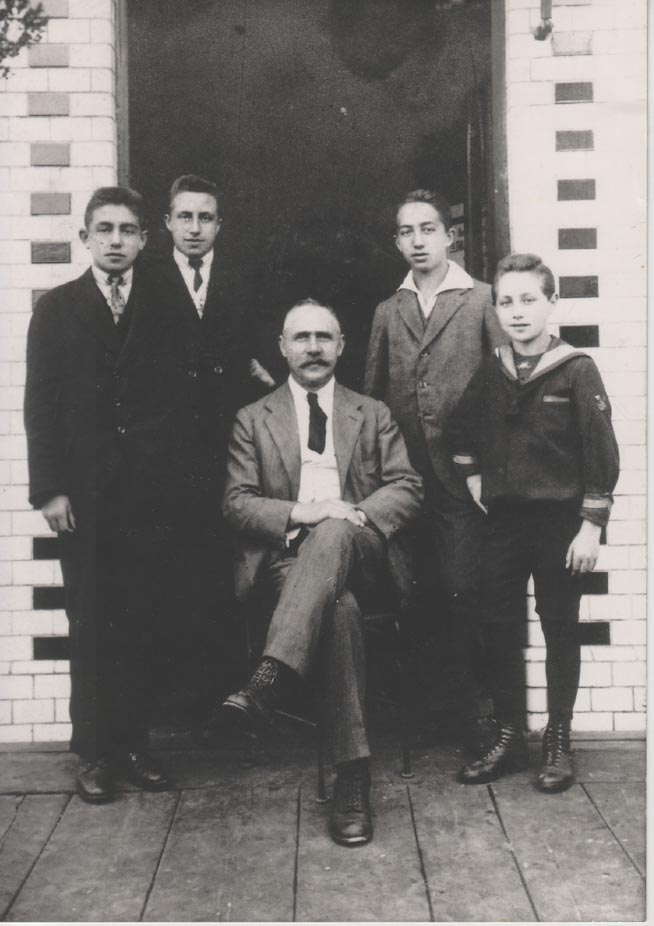
When the Nazis annexed Austria in the Anschluss of March 1938, the boys all prepared to escape to America. My own grandparents managed to flee on the day after Kristallnacht in November 1938. But Siegmund and Kamilla stayed behind. Kamilla was not well and could not travel. She died of cancer in February 1940. My mother was born in New York a few months later, and her grandfather Siegmund was thrilled to hear about his first grandchild. Kamilla’s sister Malvine, a widow, had taken care of her sister and Siegmund during Kamilla’s illness. In March 1941, Siegmund and Malvine married, in part to assure that they could remain together as Jews were being moved out of their homes into collective homes in the city. The two of them tried valiantly to obtain visas to join the rest of the family in the USA, but were stymied by the bureaucracy as American immigration quotas went intentionally unfilled on order of the US State Department. In his last letter, Siegmund described how he had obtained permission to leave from Lisbon on December 5, but that Malvine could only leave in January. The attack on Pearl Harbor on December 7, 1941 made all further travel impossible.
Little is known about what Siegmund and Malvine experienced next. On July 14, 1942 they were loaded onto a train from Vienna to Theresienstadt. According to the procedures there, they must have been forced to leave all their belongings behind at the train station and had to walk two miles in the hot sun to the already overcrowded camp. As late-comers to the camp, they were housed in the hot upper attics of the buildings that were already full before they arrived. Their rations were reduced to provide food for the children and younger adults who had to work. Sickness was rampant and the death toll inside the camp during those months reached astronomical figures (in September 3,941 people died, about 6.7% of the total population).
Siegmund and Malvine suffered for two months in Theresienstadt. Siegmund had his 71st birthday and then Shabbat Rosh Hashanah on September 12. On Yom Kippur, Monday September 21, 1942, Siegmund and Malvine were ordered to board a train with 2,020 other older Jews. Transport Bp from Theresienstadt was the second transport from there to Treblinka. The train likely arrived on September 23 or 24. Upon arrival every single one of the passengers who survived the journey were stripped of their clothing and then forced into gas chambers designed to look like showers and murdered. The gassing process took about twenty minutes. Afterwards, their bodies were dumped in trenches nearby.
Treblinka, a killing center hidden in a sparsely populated forest and designed expressly for the murder of Jews, only became operational as an extermination camp in July 1942. Between July and September, 265,000 Jews from the Warsaw ghetto were murdered there. By April 1943, after just ten months, between 800,000 to 920,000 Jews were murdered in Treblinka, a total second only to Auschwitz where the killing lasted much longer.
You don’t hear much about Treblinka because it was not also a work camp, as Auschwitz was, and so there were almost no survivors. It doesn’t live in our imagination. But I sometimes try to imagine what it was like for Siegmund and Malvine: to be left behind as their children fled, forced out of their home, stripped of their belongings, housed in unbearable conditions, and then told on Yom Kippur to board a crowded train, only to be murdered at its destination.
Postscript. I had intended to relate my comments to the war in Gaza and the ongoing offensive misuse of the term “genocide” to describe that conflict, but was advised by Sinai clergy that we were “staying away from speaking about Gaza.” This made me sad, but I complied. If we cannot discuss these issues openly, even before an audience of Jews who are largely, if not unanimously, in agreement, then we are lost.